Part 3_ The Lingqu Bus Protocol — Breaking the Interconnect Bottleneck (4)

In Parts 1 and 2, we explored how Tau Law redefines chip evolution through temporal scaling, and how Logic Folding compresses signal delay within a single chip. But there is a problem that no amount of internal chip optimization can solve: what happens when multiple chips need to talk to each other?
This is where the Lingqu Bus Protocol (灵衢总线协议) comes in — Huawei's answer to the interconnect bottleneck that has become the defining constraint of modern computing systems.
The Problem: The Chip Island Dilemma
Modern high-performance computing systems — whether data centers, AI training clusters, or advanced smartphones — rarely rely on a single chip. They use multiple chips working together: CPUs, GPUs, NPUs, memory controllers, I/O hubs, and accelerators, all needing to exchange massive volumes of data at blazing speed.
The traditional approach connects these chips through standardized bus protocols — PCIe, AXI, AMBA, and their variants. These protocols were designed decades ago for a very different computing world. They suffer from several fundamental limitations:
High latency. Data traveling between chips passes through multiple protocol conversion layers, each adding overhead. A signal that takes nanoseconds to cross a chip can take microseconds to reach another chip — a thousand-fold slowdown.
Rigid topology. Traditional bus architectures assume a fixed, hierarchical structure — master-slave relationships, rigid address spaces, predetermined routing paths. This works fine for simple systems but becomes a straitjacket for complex, heterogeneous computing.
Scalability wall. As more chips are added to a system, contention for bus bandwidth increases dramatically. Performance does not scale linearly — it often degrades.
Distance limitation. Electrical signaling over traditional copper interconnects degrades rapidly beyond a few centimeters. Chips in a server rack, or even on a large motherboard, cannot communicate efficiently.
In essence, individual chips have become blazingly fast islands, but the bridges connecting them remain narrow, slow, and congested. The system's overall performance is bottlenecked not by the chips themselves, but by the interconnect between them.
The Solution: Lingqu — A New Interconnect Philosophy
The name "Lingqu" (灵衢) carries meaning. "Ling" (灵) means agile, intelligent, adaptive. "Qu" (衢) means thoroughfare, a grand intersection where many roads converge. Together, Lingqu envisions an interconnect that is not a rigid pipeline but an intelligent, adaptive, high-speed thoroughfare for data.
Lingqu is not merely a faster bus. It is a fundamental rethinking of how computing components communicate, built on three core principles:
Principle 1 — Latency-first design. Every architectural decision in Lingqu prioritizes minimizing signal propagation time. Where traditional protocols optimize for throughput or compatibility, Lingqu optimizes for speed of delivery.
Principle 2 — Topology-agnostic flexibility. Lingqu does not assume a fixed chip arrangement. It supports point-to-point, mesh, ring, tree, and hybrid topologies, dynamically adapting to whatever system architecture it is deployed in.
Principle 3 — Distance-extensible signaling. By integrating optical interconnect technology, Lingqu extends high-bandwidth, low-latency communication far beyond the traditional centimeter-scale boundary of electrical signaling.
How Lingqu Works
Lingqu operates across three layers:
Physical Layer — Optical-Electrical Hybrid
Traditional chip-to-chip communication relies entirely on electrical signaling through copper traces. This works well over short distances but suffers from signal degradation, electromagnetic interference, and bandwidth limitations over longer runs.
Lingqu introduces optical interconnects at the physical layer. Electrical signals are converted to light at the transmitting chip, transmitted through optical waveguides or fibers, and converted back to electrical signals at the receiving chip.
The advantages are dramatic:
●
Distance: Optical signaling maintains signal integrity over distances up to 100 meters, compared to centimeters for electrical signaling. This means chips in different server blades, or even different racks, can communicate as if they were on the same board.
●
Bandwidth: Optical channels support vastly higher bandwidth density — multiple wavelengths can be multiplexed on a single fiber, each carrying independent data streams.
●
Interference immunity: Light does not suffer from electromagnetic interference, eliminating a major source of signal corruption in dense computing environments.
Protocol Layer — Streamlined Data Transport
Lingqu strips away the protocol overhead that accumulates in traditional bus architectures. Instead of passing data through multiple conversion and encapsulation layers, Lingqu uses a lean, unified transport format that minimizes serialization delay.
Key features include:
●
Zero-copy data movement: Data does not need to be copied between intermediate buffers as it traverses the interconnect. It flows directly from source to destination.
●
Adaptive routing: Packets are routed dynamically based on real-time congestion conditions, avoiding hotspots and balancing load across available paths.
●
Hardware-native flow control: Congestion management is handled in silicon, not software, eliminating the latency of software-based flow control mechanisms.
System Layer — Unified Address Space
Perhaps Lingqu's most ambitious feature is its support for a unified address space across heterogeneous chips. In traditional systems, each chip has its own memory space, and cross-chip data access requires explicit data transfer operations. Under Lingqu, multiple chips — whether CPU, GPU, NPU, or custom accelerator — can share a single, coherent memory space.
This means a task running on an NPU can directly access data stored in a CPU's memory without any explicit copy operation. The interconnect handles address translation, coherence, and routing transparently.
The effect is transformative: multiple specialized chips begin to behave as a single, unified computing organism rather than a collection of isolated processors.
The Numbers: What Lingqu Achieves
Huawei has published performance data demonstrating Lingqu's impact:
Inter-chip communication latency: Reduced by up to 500× compared to traditional PCIe-based interconnects. A data transfer that previously took microseconds now completes in nanoseconds.
Effective communication distance: Extended from centimeters to 100 meters through optical interconnect integration. This fundamentally changes system architecture — physical proximity is no longer a hard constraint.
Bandwidth efficiency: Near-linear scaling as more chips are added to the system. Unlike traditional buses that degrade under load, Lingqu maintains consistent per-chip bandwidth.
Protocol overhead: Reduced by eliminating multiple layers of encapsulation and conversion, freeing up bandwidth for actual data payload.
Why This Matters Strategically
Lingqu addresses a critical dimension of Huawei's competitive position that extends beyond chip manufacturing:
System-level performance independence. Even if individual chip performance is constrained by process node limitations, system-level performance can be dramatically amplified through superior interconnect architecture. A cluster of mature-node chips connected by Lingqu can outperform a smaller number of advanced-node chips connected by traditional interconnects.
Data center and AI implications. Modern AI training workloads require thousands of accelerators communicating in tight synchronization. Lingqu's low-latency, long-distance, high-bandwidth interconnect is purpose-built for this exact scenario — enabling large-scale AI clusters that scale efficiently without the interconnect becoming the bottleneck.
Ecosystem leverage. By defining a new interconnect standard, Huawei positions itself not just as a chip maker but as an architecture company — one that shapes how the entire computing ecosystem is structured.
The Bigger Picture: From Chip to System
With Part 1 (Tau Law), Part 2 (Logic Folding), and now Part 3 (Lingqu), a complete picture emerges:
●
Logic Folding optimizes delay within a single chip — making the internal roads faster.
●
Lingqu optimizes delay between chips — making the highways connecting different cities faster.
●
Tau Law is the unifying philosophy — systematic reduction of τ (delay) at every level, from transistor to system.
Together, they form a complete vertical stack of temporal scaling: device → circuit → chip → system. No layer is left unoptimized. No source of delay is ignored.
One-Sentence Summary
Lingqu extends Tau Law's temporal scaling philosophy beyond the chip boundary — turning a collection of isolated processors into a unified, low-latency computing organism connected by intelligent optical interconnects.
Related Articles
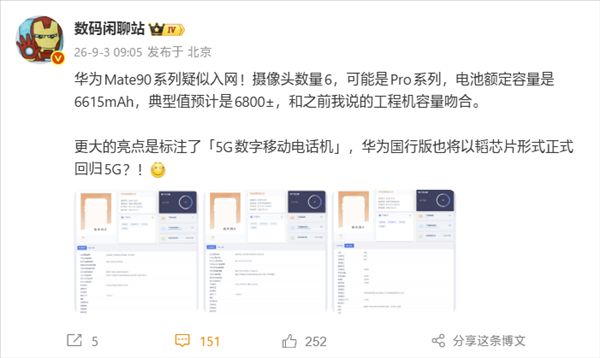
Huawei Mate 90 series has entered the network: directly marked as 5G! Debuting the Taolaw-compliant Kirin chip.
1 day ago

Xiaomi 18 Fold Three Major Debuts: Xuanjie 03 + ChangXin LPDDR6 Memory + HyperOS 4
1 day ago

Acer launches Aspire G 3D 16 laptop: Strix Halo chip with glasses-free 3D display support.
1 day ago