Huawei Mate 90 series has entered the network: directly marked as 5G! Debuting the Taolaw-compliant Kirin chip.
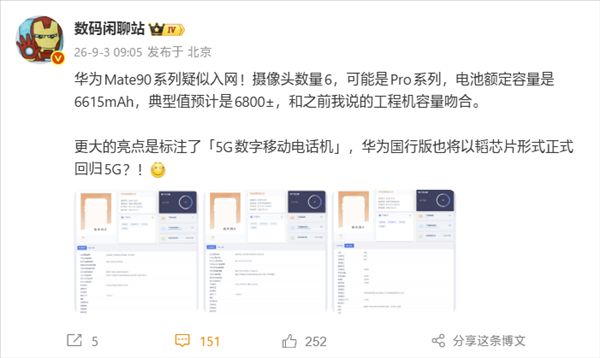
According to blogger Digital Chat Station, Huawei Mate 90 series has entered network certification. Based on the 6 cameras (including front camera + Red Maple) shown in the certification info, this appears to be the Pro version.
The rated battery capacity is 6615mAh, with a typical value expected to be around 6800±, matching the previously leaked engineering unit capacity.
The certification info doesn't reveal much more, but there's one major highlight — it's directly labeled as a "5G digital mobile phone."
This could mean that Huawei's domestic phones will officially return to 5G with the Taoding Law generation.
This time, the Mate 90 series includes three models, expected to be the Mate 90, Mate 90 Pro, and Mate 90 Pro Max.
Among them, the Mate 90 Pro Max is the top-tier version, featuring a 6.9-inch 1.5K LTPO flat display with Tandem dual-layer OLED technology and BT.2020 wide color gamut support.
The screen retains the large R-corner design, with the front camera and face recognition area openings unchanged. The engineering unit uses a BOE display.
Tandem dual-layer OLED stacks two OLED light-emitting layers, reducing the load on each layer's light-emitting material at the same brightness, thereby boosting peak brightness, lowering power consumption, and extending screen lifespan.
However, due to the higher costs of materials, driving, and packaging processes for dual-layer OLED, it's currently mainly used in higher-positioned flagship products.
In terms of performance, the Mate 90 series will debut the Taoding Law chip, officially named Kirin 9050 and Kirin 9050 Pro.
This is the world's first mass-produced phone chip featuring logic folding technology, upgrading the core logic circuits to a dual-layer vertical stacked architecture, replacing traditional "geometric scaling" with "time scaling." Without relying on more advanced lithography processes, it achieves a leap in performance and energy efficiency. According to data previously released by Huawei, the chip's transistor density increases by 53.5%, reaching 238 million transistors per square millimeter; P-core energy efficiency improves by 41%, and maximum frequency increases by 12.7%.
Related Articles
Xiaomi 18 Fold Three Major Debuts: Xuanjie 03 + ChangXin LPDDR6 Memory + HyperOS 4
1 day ago

Acer launches Aspire G 3D 16 laptop: Strix Halo chip with glasses-free 3D display support.
1 day ago
Xiaomi's most premium phone to date! Xiaomi 18 Fold wide-folding real machine unveiled: powered by Xuanjie O3, will it start at 10,000 yuan?
1 day ago