
China has achieved a new breakthrough in its independently developed superconducting quantum computer: transmission efficiency reaches as high as 98%.
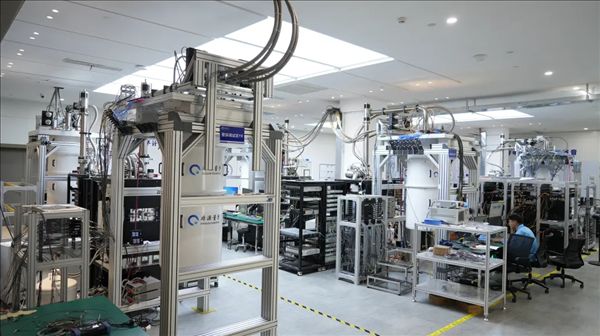
Origin Quantum, in collaboration with research teams from the University of Science and Technology of China and the Institute of Artificial Intelligence at the Hefei Comprehensive National Science Center, has successfully developed a "coherent quantum routing system" on the independently developed "Origin Wukong" superconducting quantum computer, offering a new pathway to address the scalability challenges of bucket-brigade quantum random access memory (QRAM).
Quantum random access memory (QRAM) is a critical functional module for implementing algorithms such as quantum search and quantum machine learning. Its core component is the "quantum router," which is responsible for accurately delivering data to target locations based on address instructions.
However, traditional routing schemes suffer from a critical limitation: as network scale grows, each additional node requires a large number of standard quantum gates to decompose instructions layer by layer, leading to a sharp increase in circuit depth and error accumulation, severely constraining QRAM scalability.
To address this challenge, the research team proposed a quantum router construction scheme based on auxiliary energy levels. The "coherent quantum routing system" leverages the auxiliary energy levels of superconducting qubits to transform complex controlled-swap operations into shallow circuits composed of a small number of two-qubit transition gates, effectively reducing circuit depth and error accumulation. This is equivalent to building an "express lane" on congested data channels, allowing data to bypass redundant nodes and reach target addresses directly.
The researchers physically constructed three independent quantum routers and a two-layer routing network on the "Origin Wukong" superconducting quantum computer for testing.
Results show that the information transmission efficiency of a single quantum router reaches 98%, while the overall transmission efficiency of the two-layer routing network reaches 93%. In random access tests, the average fidelity of a single router is 94.8%, and the average fidelity of the two-layer network reaches 82.4%.
The data indicates that this scheme enables coherent, reversible routing controlled by quantum addresses and holds potential for scaling to larger networks.
The researchers stated that this breakthrough not only provides a new pathway for building scalable QRAM on existing superconducting hardware, but also marks a transition in China's quantum computing R&D from single-dimensional performance optimization to the validation stage of complex quantum functions on real hardware.
By leveraging the intrinsic properties of quantum devices, this scheme enables lower-cost and higher-efficiency computation, opening new directions for the co-optimization of quantum chips and circuits.
Related Articles

Huawei Mate 90 series has entered the network: directly marked as 5G! Debuting the Taolaw-compliant Kirin chip.
1 day ago

Xiaomi 18 Fold Three Major Debuts: Xuanjie 03 + ChangXin LPDDR6 Memory + HyperOS 4
1 day ago

Acer launches Aspire G 3D 16 laptop: Strix Halo chip with glasses-free 3D display support.
1 day ago