
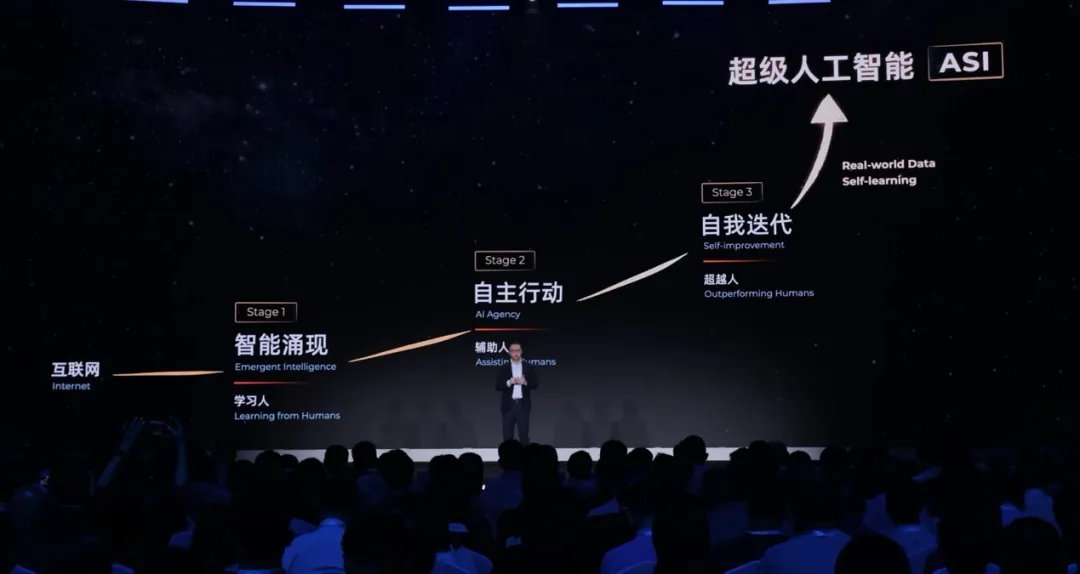
Wu Yongming highlighted that we are at the dawn of a new intelligence revolution driven by artificial intelligence (AI). Unlike past revolutions—industrial (mechanization of physical power) and informational (digital amplification of information processing)—this revolution will amplify and liberate human intelligence, ultimately paving the way for Artificial General Intelligence (AGI) and later Artificial Superintelligence (ASI).
Key Points:
- Rapid AI Evolution
- In just three years, AI intelligence has advanced from a high school level to a PhD level, even capable of winning international competitions like the IMO.
- The global AI industry has attracted over $400 billion in investment in the past year, with cumulative spending projected to exceed $4 trillion in five years, accelerating model breakthroughs and AI adoption.
- Three Stages Toward ASI
- Stage 1 – Intelligence Emergence (“Learning Humans”)
AI learns by understanding the entire body of human knowledge, enabling general dialogue, reasoning, and problem-solving. - Stage 2 – Autonomous Action (“Assisting Humans”) (current stage)
AI goes beyond language interaction to take real-world actions, using tools (Tool Use) and coding capabilities to execute complex tasks across industries such as logistics, manufacturing, healthcare, finance, and research. - Stage 3 – Self-Iteration (“Surpassing Humans”)
AI directly interacts with the physical world, collects raw real-world data, and uses self-learning to autonomously improve models. This will lead to early-stage ASI that can solve problems beyond human comprehension.
- Stage 1 – Intelligence Emergence (“Learning Humans”)
- Impact of ASI
- ASI will generate “super scientists” and “full-stack engineers” capable of tackling humanity’s biggest challenges—medical breakthroughs, new materials, sustainable energy, climate solutions, and even interstellar travel.
- Human productivity will experience exponential growth, similar to how electricity amplified physical power in the past.
- AI and the Future of Technology Infrastructure
- Large Language Models (LLMs) as the New Operating System
- LLMs will replace traditional OS as the central platform, enabling anyone to create applications and agents using natural language.
- Future software will be AI-generated agents rather than manually coded commercial software.
- Super AI Cloud as the Next Computer
- AI will run on massive cloud networks, requiring millions of GPUs, high-density computing, and enormous energy resources.
- Tokens will become the “electricity” of the AI era, powering all AI-driven tasks.
- Large Language Models (LLMs) as the New Operating System
- Alibaba’s Strategy
- Tongyi Qianwen, Alibaba’s open-source large model, has been downloaded over 600 million times, with 170,000 derivative models, making it the most popular open-source model ecosystem globally.
- Alibaba Cloud is investing 380 billion RMB over three years to build next-gen AI infrastructure and a vertically integrated super AI cloud to support global developers.
- Human-AI Collaboration
- Future humans will work alongside countless AI agents and robots, with each individual potentially relying on the equivalent of 100 GPUs to enhance productivity.
- This collaboration will evolve from “Vibe Coding” to “Vibe Working”, where humans focus on creativity and strategy while AI handles most execution tasks.
Conclusion
Wu emphasized that this is only the beginning of the AI-driven intelligence revolution. AI will reshape infrastructure, software, and applications, becoming the central driver of the real-world economy. Alibaba aims to partner globally to integrate AI deeply into industries and jointly shape a future powered by ASI.
Souce: 2025 APSARA CONFERENCE