
Why MONA L03 doesn't use 800V high-voltage architecture - Xiaopeng executive's detailed response clarifies

The recently launched Xiaopeng MONA L03 has undoubtedly been a massive success, with 46,800 pre-orders within the first hour. However, some voices have said that the car not using an 800V high-voltage architecture is a clear downgrade. So, what is Xiaopeng's response?
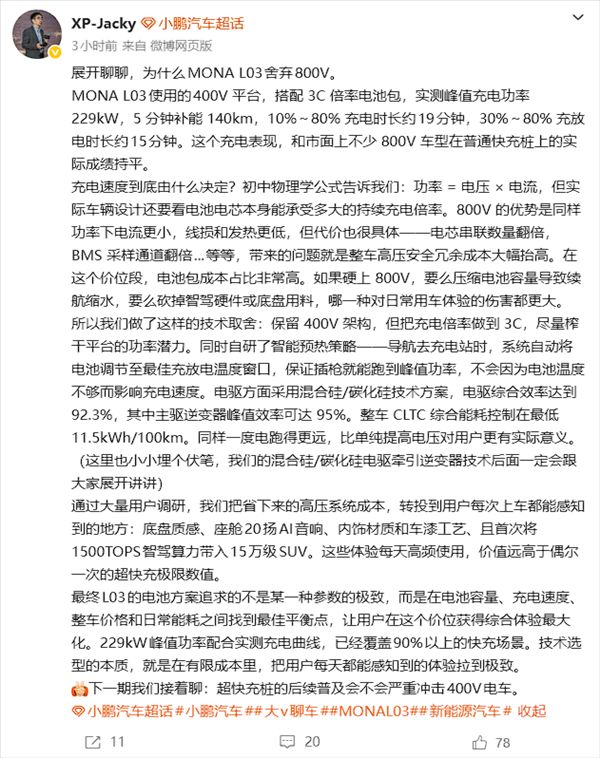
At noon today, Xiaopeng Motors' Senior Director of Powertrain, @XP-Jacky, posted a detailed explanation:
The MONA L03 uses a 400V platform paired with a 3C-rate battery pack. Actual peak charging power is 229kW, with a 5-minute recharge providing 140km of range. The 10% to 80% charging time is approximately 19 minutes, and the 30% to 80% charge/discharge time is around 15 minutes. This charging performance is on par with the real-world results of many 800V vehicles on standard fast-charging piles.
What actually determines charging speed? A middle school physics formula tells us: Power = Voltage × Current, but in actual vehicle design, you also need to consider the sustained charging rate that the battery cells themselves can handle.
The advantage of 800V is that at the same power level, current is lower, reducing line losses and heat generation. However, the trade-offs are significant — the number of battery cells in series doubles, the BMS sampling channels double, and so on. This leads to substantially higher costs for the vehicle's high-voltage safety redundancy.
In this price segment, the battery pack accounts for a very high proportion of the cost. Forcing 800V would either mean cutting battery capacity (reducing range) or sacrificing intelligent driving hardware or chassis materials — either of which would cause greater harm to daily driving experience.
So we made this technical trade-off:
We retained the 400V architecture but increased the charging rate to 3C, fully exploiting the platform's power potential. At the same time, we developed our own intelligent preheating strategy — when navigating to a charging station, the system automatically adjusts the battery to the optimal charge/discharge temperature window, ensuring peak power from the moment you plug in, without charging speed being affected by insufficient battery temperature.
In terms of the electric drive, we adopted a hybrid silicon/silicon carbide technology solution, achieving a combined drive efficiency of 92.3%, with the main drive inverter peak efficiency reaching 95%. The vehicle's overall CLTC energy consumption is controlled at a minimum of 11.5kWh/100km, meaning it goes further per kWh of electricity — which is more practically meaningful for users than simply increasing voltage.
He also stated that through extensive user research, the cost saved from the high-voltage system was reinvested into areas that users can perceive every time they get into the car: chassis quality, the 20-speaker AI sound system in the cabin, interior materials and paint craftsmanship, and for the first time, bringing 1500 TOPS of intelligent driving computing power to a 150,000-yuan-level SUV. "These features are used daily with high frequency, and their value far exceeds the extreme numbers of an occasional ultra-fast charge."
Ultimately, the L03's battery solution does not pursue the extreme of any single parameter; rather, it seeks the best balance between battery capacity, charging speed, vehicle price, and daily energy consumption, maximizing the overall experience for users at this price point.
With a peak power of 229kW and the actual charging curve, it already covers over 90% of fast-charging scenarios. "The essence of technology selection is to push the user's daily-perceived experience to the extreme within a limited cost."
Related Articles

Starting at 1.388 million yuan, Zunjie S800 Grand Design Collection officially delivered
about 2 hours ago
6 out of every 10 electric vehicles are BYD! Chinese cars dominate overseas markets: foreigners queue up to take delivery.
2 days ago

BYD released its 2026 semi-annual financial report: exports surged 67.9% to nearly 790,000 vehicles!
3 days ago