
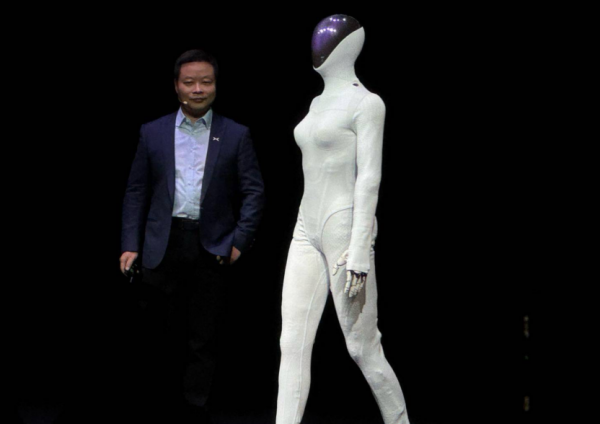
At its recent AI Technology Day, XPeng Motors officially unveiled its next-generation IRON humanoid robot, marking a major step toward large-scale humanoid AI applications. The company confirmed that mass production of the IRON robot is planned for the end of 2026, alongside progress on its upcoming Robotaxi initiative.
The IRON robot is powered by XPeng’s second-generation VLA large model and features three Turing AI chips, achieving a total computational power of 2,250 TOPS. The robot integrates XPeng’s advanced “VLT + VLA + VLM” system, which combines high-level perception, reasoning, and multimodal learning—forming what XPeng describes as a “high-order brain” for physical AI.
XPeng highlighted seven key technological breakthroughs in the IRON humanoid robot:
- Bionic Design – A human-like spine, muscle structure, and flexible full-body skin enable realistic movements such as bending and ground-level interaction.
- Dexterous Hands – 22 degrees of freedom allow for intricate manipulation and fine-motor control.
- Interactive Display – A 3D curved display on the head integrates “hearing, speech, vision, and facial expression” functions for natural human–robot interaction.
- Power System – Industry-first use of solid-state batteries provides ultra-lightweight construction and exceptional energy density.
- Safety Mechanism – Built-in active safety protection ensures physical and operational security in human environments.
- Privacy Safeguards – Incorporates a “fourth law of robotics” principle to ensure user data remains private and stored only within the robot.
- Open Ecosystem – With an open SDK, XPeng invites global developers to co-create applications for the humanoid robot platform.
XPeng has also established its first Embodied Intelligence Data Factory in Guangzhou, which will serve as the backbone for training, testing, and scaling its humanoid robotics technologies. The company said this facility will play a pivotal role in achieving mass production of advanced humanoid robots by late 2026, signaling China’s emergence as a major player in the global humanoid robotics race.
