The x86 PC marks its 45th anniversary: of the 12 CPU companies, only Intel and AMD remain thriving
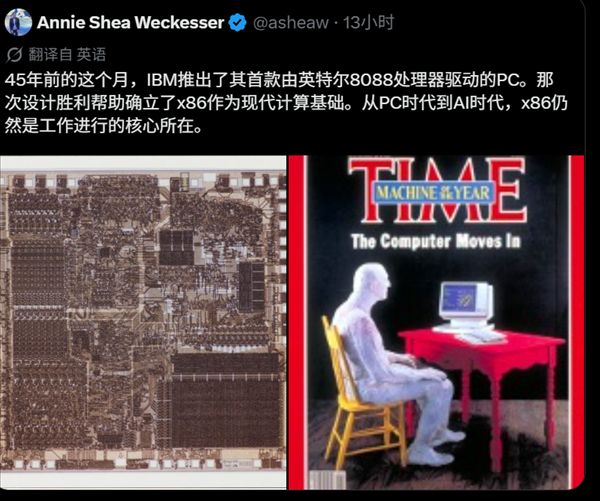
This month marks the 45th anniversary of the x86 PC. In August 1981, the IBM PC debuted as the progenitor of personal computers, and IBM's choice of the 8088 processor laid the foundation for PC processors, ultimately transforming Intel from a memory company into a CPU company.
This history is revisited every year, but it always offers fresh insights. IBM's decision also sparked the boom of PC CPUs. Everyone knows Intel is the leader in this field, with AMD as the runner-up. Back then, AMD's ability to make x86 chips stemmed from IBM's requirement for a second supplier beyond Intel, prompting Intel to license x86 to AMD.
But in that era, after Intel and AMD gained prominence, many other companies also entered the x86 market, producing their own x86-compatible processors at lower prices than Intel, capturing a significant share of the market.
Former AMD executive @PatrickMoorhead shared a list naming 12 notable x86 companies—of course, Intel and AMD go without saying.
1/ Intel: Creator of the x86 architecture.
2/ AMD (Advanced Micro Devices): Initially a licensed second-source supplier for Intel, later designing independent x86 chips (e.g., Am386, Am486, K5, K6).
3/ Cyrix: A major third-party supplier in the 1990s, known for low-cost alternative CPUs like the 486DLC, 5x86, and 6x86.
4/ IBM: Produced Intel-licensed second-source chips and manufactured custom Cyrix variants under its own brand.
5/ NEC: An early pioneer that designed x86-compatible CPUs (e.g., NEC V20/V30 series), which outperformed the original Intel 8088/8086 chips.
6/ Texas Instruments (TI): Manufactured and sold Cyrix designs while developing some proprietary microarchitecture tweaks.
7/ SGS-Thomson (STMicroelectronics): Manufactured and marketed Cyrix-designed x86 microprocessors.
8/ NexGen: Designed innovative x86 chips (like the Nx586) that translated x86 instructions into RISC-like micro-ops; later acquired by AMD.
9/ IDT (Centaur Technology): Entered the market in the late 1990s, known for the cheap, low-power WinChip series.
10/ Rise Technology: Produced the mP6 processor targeting budget laptops.
11/ UMC (United Microelectronics Corp): Produced 386 and 486 clone chips in the early 1990s, later forced out by Intel's patent lawsuits.
12/ Transmeta: Entered the market slightly later in the late 1990s, using Code Morphing software to dynamically translate x86 instructions.
Beyond AMD and Intel, the x86 CPU companies mentioned here either exited long ago, were acquired, or went bankrupt. Their departure wasn't entirely due to uncompetitive products—Intel progressively tightened x86 licensing and launched a series of legal actions. Even AMD faced litigation over x86; Intel didn't succeed in revoking the license, not for lack of trying.
Of course, AMD scored a major victory in the x64 era—the 64-bit x86 intellectual property was pioneered by AMD, and now the two sides cross-license to each other.
Additionally, PatrickMoorhead's list isn't exhaustive; a significant player was omitted—VIA Technologies. VIA successively acquired Cyrix and Centaur, and obtained IDT technology, making it another x86 CPU company. It outlasted most companies on the list and is still around today.
VIA was once called the third-largest x86 company, but its licensing fell behind long ago, and it hasn't pursued advanced CPU development for years, so it has little market impact now.
Meanwhile, in a distant Eastern country, two companies are still working on x86 CPUs—one under a licensing partnership with VIA, the other under one with AMD. But they face significant restrictions and pose little threat to AMD or Intel, so Intel hasn't taken legal action. It's worth watching going forward. Intel's protection of x86 intellectual property is extremely strict—even Microsoft's attempt to translate ARM to x86 instructions triggered a response from Intel, and there's a reason that effort has never fully succeeded.
Related Articles
Huawei phone users have finally got what they've been waiting for! The HarmonyOS trial beta version of NetEase Cloud Music is now available.
about 4 hours ago
The price after discounts is 6544 yuan! Lenovo ThinkPad E14 2026 laptop is now available: Core 5 320 + 512GB
about 5 hours ago