The United States once again wields the tariff stick: will impose an additional 50% tariff on Canadian automobiles and steel!
The trade friction between the US and Canada continues to escalate. After the first round of tariffs took effect and bilateral negotiations collapsed, the US has issued another heavyweight threat.
Trump has officially announced plans to impose a 50% tariff on all cars, trucks, complete vehicle components, and steel from Canada starting January 1, 2027. These categories were not included in the previous tariff list.
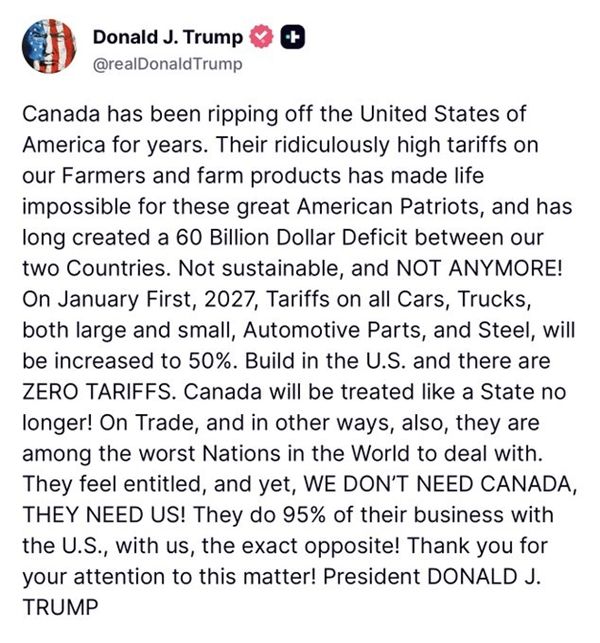
The following is the original text shared by Trump:
Canada has been taking advantage of the US for years. Canada imposes outrageously high tariffs on American farmers and agricultural products, making life difficult for these great American patriots, and has also created a long-standing $60 billion trade deficit between the two countries. This situation cannot continue—it ends now!
Starting January 1, 2027, tariffs on all cars, trucks, automotive components, and steel will be raised to 50%.
If production occurs within the US, it will enjoy zero-tariff treatment. Canada will no longer be treated as if it were a US state!
In trade and many other respects, Canada is one of the most difficult countries to deal with.
They always think they deserve preferential treatment, but the reality is: we don't depend on Canada—Canada depends on us! 95% of Canada's trade business is conducted with the US. The situation is completely reversed!
It is understood that the root of this round of disputes lies in agricultural market access conflicts. The US accuses Canada of setting trade barriers through rules related to dairy products and alcohol, compounded by a bilateral trade deficit of approximately $60 billion, used as leverage for pressure.
In July, the US announced a 50% tariff on Canadian alcohol, building materials, and other goods, originally scheduled to take effect on August 19. It was briefly postponed due to negotiations but ultimately took effect on August 22, without covering automotive and steel categories.
During multiple rounds of negotiations, both sides at one point signaled compromise, but the US added harsh conditions, and negotiations completely collapsed. Canada subsequently announced retaliatory tariffs to take effect starting September 8.
To further pressure Canada into concessions, the US has now targeted the deeply integrated North American automotive supply chain, setting a buffer period of over four months rather than immediate implementation—both leaving a window for negotiations and reducing the immediate impact on US automakers.
The North American automotive industry is highly integrated, with a large volume of Canadian vehicles and components supplying US factories. Once the 50% tariff takes effect, cross-border production costs will rise significantly, directly impacting the regional supply chain and pushing up vehicle prices.
It should be noted that this policy is currently just an external announcement, and there remains the possibility of negotiation adjustments. Canada will likely also introduce corresponding countermeasures.
Related Articles

Huawei phone users have finally got what they've been waiting for! The HarmonyOS trial beta version of NetEase Cloud Music is now available.
about 4 hours ago

The price after discounts is 6544 yuan! Lenovo ThinkPad E14 2026 laptop is now available: Core 5 320 + 512GB
about 5 hours ago