The thing Germans feared most has happened! China-exclusive AUDI electric vehicles are being sold back to Audi's home turf.
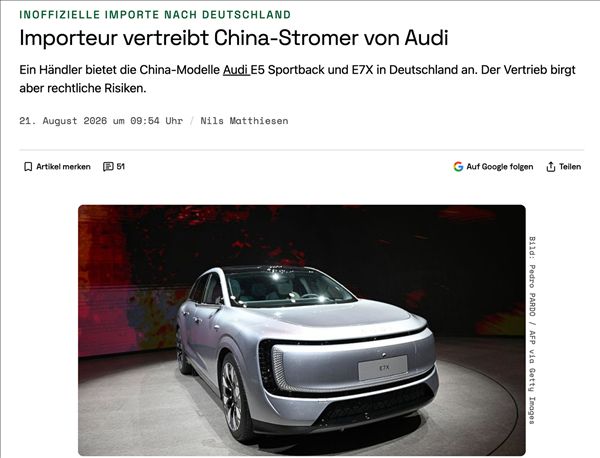
The scene Germans least wanted to see has unfolded:
The AUDI E5 Sportback coupe and E7X SUV, two all-electric models originally co-developed by Audi and SAIC exclusively for the Chinese market with no European export plans, have officially landed in Audi's home turf of Germany. Purchased, shipped by sea, and certified under EU regulations by German third-party parallel importer Auto China, they are now legally registrable and drivable on German roads.
These two models belong to AUDI, the sub-brand Audi established specifically for China. Built on the jointly developed ADP advanced digital platform, they no longer feature Audi's classic four-ring logo on the exterior, with the rear replaced by uppercase "AUDI" lettering.
Deeply adapted to China's in-car ecosystem, intelligent cockpit, and local user habits, they were positioned for the Chinese market from the start of development. The Volkswagen Group officially stated it has no plans to export these two models to European markets.
The price contrast is stark: the E5 Sportback starts at 205,900 yuan domestically, and the E7X at 269,800 yuan. After stacking procurement costs, ocean shipping, EU countervailing duties, VAT, and individual vehicle certification, prices in Germany nearly double—the E5 Sportback is listed at 59,980 euros before tax, while the E7X starts at 72,900 euros.
Even with significantly higher costs, they still hold a clear advantage over comparable Audi EVs produced in Germany:
The top-spec dual-motor E5 Sportback delivers up to 776 horsepower, hits 0-100 km/h in 3.4 seconds, and features a 100kWh 800V high-voltage battery with a CLTC range of 647 kilometers. Meanwhile, the German-built Audi S6 Sportback e-tron offers only 543 horsepower yet costs nearly 28,000 euros more—lower performance, higher price, a stark contrast.
In terms of hardware, both China-exclusive models come with large central touchscreens, a fully localized intelligent cockpit, and advanced driver assistance systems, with cabin interaction and connected-car features all tuned to Chinese consumer preferences.
The irony here is that the Volkswagen Group had been lobbying the EU to impose tariffs blocking Chinese-made EVs from entering the European market—yet the first to break into Germany turned out to be its own China-produced limited models.
The German domestic auto industry is divided in response: some dealers have expressed concerns, warning of potential risks in residual value and maintenance for imports, while many ordinary German consumers are highly interested. Meanwhile, numerous Chinese netizens have taken to social media to complain that, despite being the same Audi technology, locally sold models in Germany offer weaker performance at higher prices.
Related Articles
Starting at 1.388 million yuan, Zunjie S800 Grand Design Collection officially delivered
about 3 hours ago
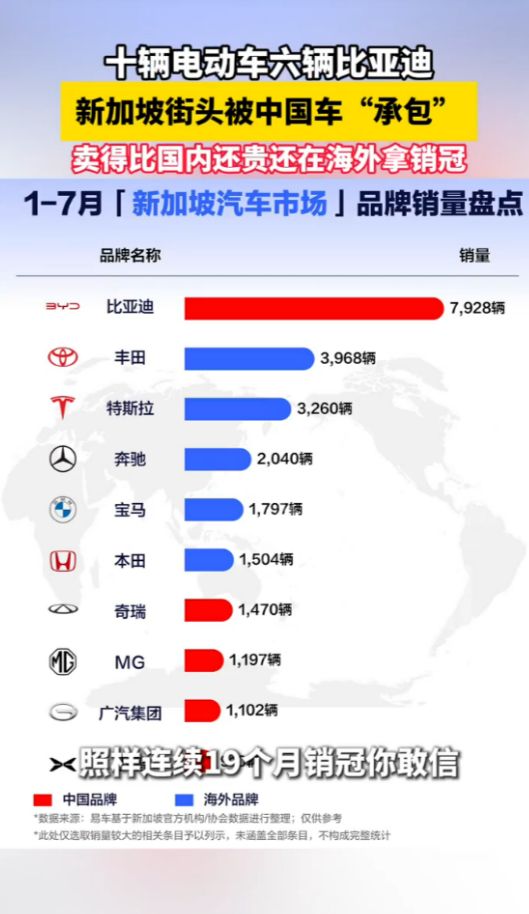
6 out of every 10 electric vehicles are BYD! Chinese cars dominate overseas markets: foreigners queue up to take delivery.
2 days ago
BYD released its 2026 semi-annual financial report: exports surged 67.9% to nearly 790,000 vehicles!
3 days ago