Major bombshell! DeepSeek launches Agent: Harness is now open source, everything can be a plugin.
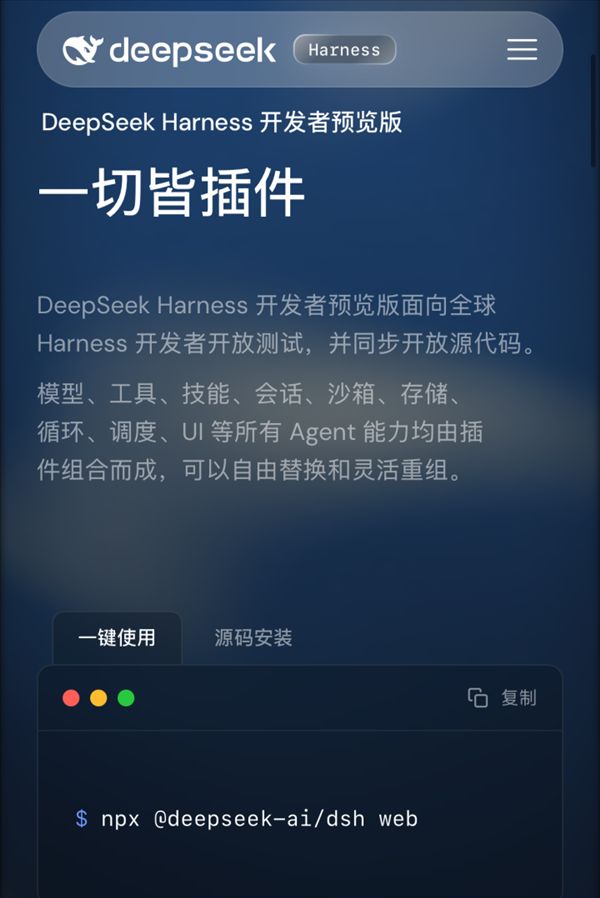
After announcing API price adjustments, DeepSeek officially launched its first Agent product on the evening of August 13 — DeepSeek Harness v0.1 Developer Preview, open-sourced directly on GitHub under the MIT license.
DeepSeek's large model capabilities have long been well-known in the industry, but Harness targets the infrastructure beyond the model itself — the complete set of systems that lets AI actually execute tasks in the real world.
The official formula is simple: Model + Harness = Agent. In plain terms: the model handles thinking and reasoning, while Harness handles actual execution.
Harness comes with built-in support for everything a local agent workbench needs: project management, long-horizon task collaboration, multi-agent orchestration, context management, web retrieval, external skill invocation, and more.
The biggest highlight of this release is its commitment to the core philosophy of "everything is a plugin."
As an early preview version, DeepSeek Harness adopts an "everything is a plugin" design approach, building the Agent Harness through a plugin-based open architecture: models, tools, skills, sessions, sandboxes, storage, loops, scheduling, UI — all agent capabilities are composed of plugins that can be freely swapped and flexibly recombined.
The entire framework is built on the Cordis plugin meta-framework. Cordis only handles the underlying work of plugin loading/unloading and dependency management, while all of Harness's business components are independent Cordis plugins.
Plugins collaborate through Cordis's service and event mechanisms, and can be freely assembled at the configuration level. Developers don't need to modify the project source code — they can customize any module and extend capabilities simply by adding or replacing plugins.
For different development scenarios, Harness comes with four preset runtime modes, each automatically loading the corresponding plugin set:
Standard mode: ships with a full set of tool components for general development;
PTC (Programmatic Tool Calling) mode: the model generates code to orchestrate multi-round chained tool calls;
Minimal mode: keeps only Shell and file editing tools, for model benchmarking in minimal environments;
Creative mode: supports viewing runtime state, in-memory debugging of Cordis plugins, and custom-generating entirely new runtime modes.
After setting up the Node.js toolchain locally, developers can quickly launch the DeepSeek Harness web interface via the npx command.
Of course, v0.1 is still a developer preview. As DeepSeek's open-source foundation for the Agent track, its future performance is worth continued industry attention, and we look forward to Harness unlocking even more room for imagination.
Related Articles

Huawei phone users have finally got what they've been waiting for! The HarmonyOS trial beta version of NetEase Cloud Music is now available.
about 4 hours ago

The price after discounts is 6544 yuan! Lenovo ThinkPad E14 2026 laptop is now available: Core 5 320 + 512GB
about 5 hours ago