Jack Ma invests over HK$600 million! Alibaba's core leadership collectively "buys, buys, buys," sending a clear signal.
According to a report from the STAR Market Daily, sources have revealed that as Alibaba launched its placement financing, founder Jack Ma has been increasing his holdings in Alibaba's Hong Kong-listed shares for several consecutive days, with the total exceeding HK$600 million, underscoring his firm confidence in Alibaba's AI prospects.
Beyond Jack Ma, Alibaba's core management team has simultaneously been intensively increasing their stakes, sending a strong bullish signal.
As previously reported, the Hong Kong Stock Exchange announced on the 25th that Alibaba Group Chairman Joe Tsai again increased his holdings of Alibaba shares by approximately HK$82 million. This marks the second consecutive trading day of personal purchases by Tsai following the new share placement, bringing his cumulative two-day increase to HK$160 million.
Looking back at earlier actions, on August 24, Tsai had already joined Alibaba CEO Eddie Wu in increasing their stakes simultaneously, with the two collectively spending about HK$120 million to acquire Alibaba shares.
The founder and core management team's successive large-scale stake increases form a combined force, fully confirming internal high recognition of the company's AI transformation strategy and long-term operational value. According to statistics, the combined recent increases by Jack Ma, Joe Tsai, and Eddie Wu have exceeded HK$800 million.
The core backdrop of this management stake increase is Alibaba's AI strategy financing plan. On the evening of August 23, Alibaba officially announced a major placement scheme, planning to place 710 million new shares at HK$112.7 per share, with total fundraising reaching HK$80 billion (approximately US$10.2 billion).
This placement set two key records: it is both Alibaba's first equity placement financing since its Hong Kong listing in 2019, and the largest primary follow-on offering in the history of the Hong Kong capital market.
Notably, 100% of the HK$80 billion raised will be directed toward full-stack AI capability building and AI infrastructure expansion, with key coverage including computing power infrastructure expansion, self-developed chip iteration, large model R&D optimization, and AI scenario commercialization.
The strong strategic appeal has also gained recognition from global capital. According to reports, the placement attracted enthusiastic subscriptions from long-term institutions including global sovereign wealth funds, ultimately achieving nearly 3x oversubscription.
Returning to Alibaba's operational fundamentals, the traditional e-commerce business is currently under pressure, and AI has become the core lever for Alibaba to break through growth bottlenecks and open a second growth curve.
According to Alibaba's fiscal 2027 first-quarter earnings report (data as of June 30, 2026), the company's total revenue for the period reached RMB 268.953 billion, up 9% year-over-year; operating profit was RMB 15.161 billion, down 57% year-over-year, with the profit fluctuation primarily stemming from high-intensity capital investment in the early stages of the AI track.
However, Alibaba's AI business has already demonstrated strong growth momentum with significant commercialization progress. Data shows that Alibaba's AI-related products have surpassed RMB 49.5 billion in annualized revenue, with expectations to exceed US$10 billion in the next quarter of 2026.
Meanwhile, management has set clear medium-to-long-term AI development goals, projecting that Alibaba Cloud's external commercialization revenue could reach US$100 billion by 2030, with a target profit margin stabilizing at 20%, and AI-related capital expenditures expected to recoup investment within 2-3 years.
High-growth tracks inevitably come with high-intensity early-stage investment. At this stage, Alibaba's AI business is in a critical phase of "exchanging investment for market share and positioning for the future through strategic layout."
Earnings data shows that Alibaba's capital expenditure for the quarter reached RMB 67.678 billion, up 75% year-over-year. Due to the substantial capital investment, the company's free cash flow expanded from a net outflow of RMB 18.815 billion in the same period last year to RMB 44.67 billion, putting short-term cash flow under pressure, primarily to build momentum for the full AI industry chain layout.
Through long-term sustained efforts, Alibaba has established a full-stack AI industry system, with business coverage spanning the entire chain from underlying computing power, self-developed chips, and general large models to industry-specific applications, forming a complete AI technology and commercial closed loop.
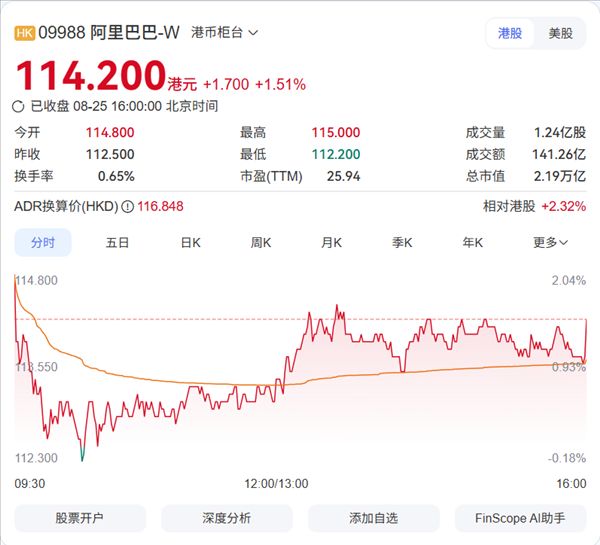
As of the Hong Kong market close on August 25, Alibaba's Hong Kong-listed shares were trading at HK$114.2 per share, with the company's total market value reaching HK$2.19 trillion.
Related Articles

Huawei phone users have finally got what they've been waiting for! The HarmonyOS trial beta version of NetEase Cloud Music is now available.
about 3 hours ago
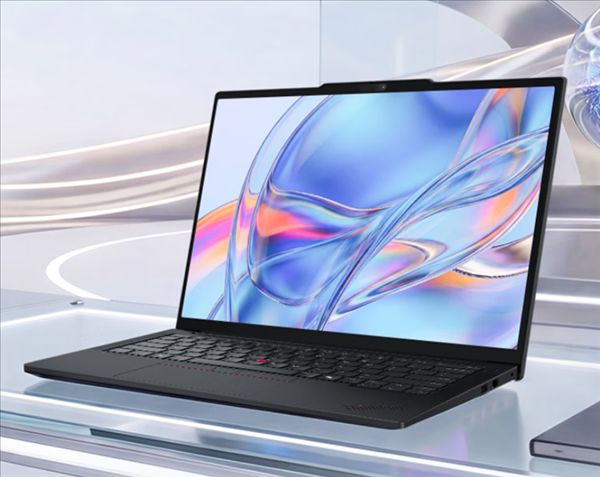
The price after discounts is 6544 yuan! Lenovo ThinkPad E14 2026 laptop is now available: Core 5 320 + 512GB
about 4 hours ago