Apple's heavyweight dual-chip lineup! The first 2nm chip M6 debuts, and the M5 Ultra unlocks a four-die architecture.
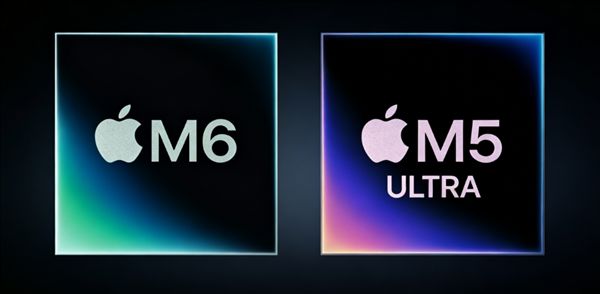
Apple has launched new Mac mini and Mac Studio models, featuring the 2nm M6 chip and M5 Ultra chip respectively, delivering a revolutionary leap in performance and AI capabilities.
The M6 is Apple's first chip built on a 2nm process, with comprehensive upgrades across all compute modules. It features a 12-core CPU, comprising 2 super cores, 4 performance cores, and 6 efficiency cores, all offering industry-leading performance-per-watt.
Single-threaded performance leads the pack, while multi-threaded performance is up to 1.2x faster than the M5 and up to 2.4x faster than the M1.
In terms of AI compute, the M6 is equipped with a dual 16-core Neural Engine, delivering up to 2x peak compute performance over the previous generation. Unified memory scales up to 32GB with bandwidth reaching 170GB/s, a 10% increase over the M5 and 2.5x over the M1.
The GPU has been upgraded to 12 cores (each with a built-in neural network accelerator), boosting peak AI compute performance by nearly 30% over the M5 and over 8x compared to the M1.
Additionally, the M6 integrates Apple's latest graphics capabilities, including an updated shader core architecture, dynamic caching, and hardware-accelerated ray tracing. Compared to the M5, the M6 adds 2 more CPU cores and 2 more GPU cores, and with improvements to the Neural Engine and memory bandwidth, it handles a wider range of workloads more efficiently.
The M5 Ultra is Apple's most powerful chip to date, built specifically for professionals. For the first time, Apple employs UltraFusion packaging technology in an M-series chip, interconnecting two dual-die M5 Max chips to form a quad-die architecture. This technology boosts inter-die bandwidth to over 4.4TB/s and increases connection density by more than 6x.
The M5 Ultra features a large CPU with up to 36 cores (including 12 super cores and 24 performance cores), delivering up to 1.25x faster single-threaded performance and up to 1.3x faster multi-threaded performance compared to the M3 Ultra.
The GPU boasts up to 80 cores, also with built-in neural network accelerators, supporting the latest shader cores, second-generation dynamic caching, hardware-accelerated mesh shading, and third-generation ray tracing, delivering up to 40% faster graphics performance than the M3 Ultra.
The media engine has been further enhanced, with dedicated hardware acceleration for H.264, HEVC, four ProRes encode/decode engines, and hardware-accelerated AV1 decoding. The 32-core Neural Engine can securely drive complex AI tasks on-device with industry-leading efficiency.
Memory configuration is equally impressive, supporting up to 512GB of unified memory with bandwidth reaching 1.2TB/s, a 50% increase over the M3 Ultra, providing ample headroom for professional creative work and ultra-large workloads.
Related Articles

Huawei phone users have finally got what they've been waiting for! The HarmonyOS trial beta version of NetEase Cloud Music is now available.
about 3 hours ago
The price after discounts is 6544 yuan! Lenovo ThinkPad E14 2026 laptop is now available: Core 5 320 + 512GB
about 5 hours ago