GPU will no longer be the top AI chip. Google's TPU count reaches 15 million by 2028, surpassing NVIDIA for the first time.
In the AI wave of recent years, NVIDIA has benefited the most, as major companies rely on its GPUs for training and inference workloads. However, within two years, GPUs may no longer dominate, as Google's TPUs are poised to overtake them.
When it comes to AI chip technology approaches, they can be broadly divided into NVIDIA's GPU-based general-purpose computing and Google's ASIC-based specialized computing. Google's custom tensor processing units (TPUs) have a decade of history, but their deployment numbers have lagged behind NVIDIA's GPUs.
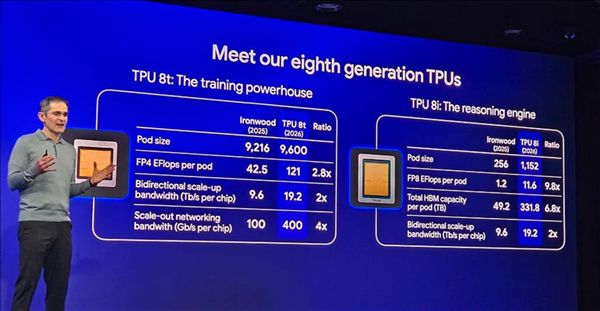
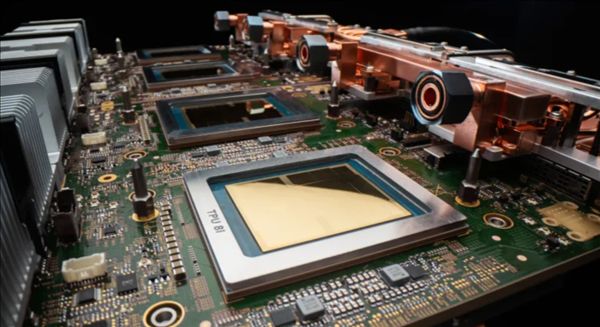
Over the past two years, however, companies have increasingly sought to avoid being fully tied to NVIDIA's graphics cards for compute chips, sparking a surge in custom AI chip development. Google's TPU deployment has grown rapidly as well. The seventh-generation TPUv7 is already deployed, and the eighth-generation TPUv8 was launched in April, marking the first time it distinguishes between training and inference-focused variants.
Among them, the V8T is geared toward AI training. Although Google says it can also handle inference, it is primarily designed for training. Each pod node stacks 9,600 V8T chips, delivering 121 EFlops of FP4 performance, equipped with 2PB of HBM memory, 19.2TB/s memory bandwidth, and 400GB/s inter-chip bandwidth — nearly all metrics are 2-4x improvements.
The V8i is mainly aimed at AI inference workloads, with significantly lower specifications. Each node contains only 1,152 V8i chips, compute power drops to 11.6 EFlops, while memory bandwidth remains at 19.2TB/s.
The next-generation ninth-generation TPUv9 will be even more powerful, featuring 4-die packaging with higher packaging requirements. In addition to TSMC, its existing partner, it will also use Intel's EMIB packaging, with approximately 3 million TPU chips allocated to Intel.
This also means the total number of TPUv9 chips in this generation is staggering. According to recent supply chain sources, Google's TPUv9 deployment in 2028 will reach 12 to 15 million chips.
What does that mean? NVIDIA's AI GPU chips supply most compute vendors on the market, with expected sales of 8.2 million units this year, rising to just 12.4 million by 2028. Google's TPUs will surpass NVIDIA's graphics cards in volume for the first time.
The fact that ASIC-based AI chip volume exceeds NVIDIA's GPUs is not surprising in itself, because major companies like Google, Microsoft, and Amazon certainly don't want their AI chips to rely entirely on NVIDIA or AMD. Using self-developed chips not only reduces costs but also decreases technical dependence on NVIDIA.
Related Articles

Huawei phone users have finally got what they've been waiting for! The HarmonyOS trial beta version of NetEase Cloud Music is now available.
about 4 hours ago
The price after discounts is 6544 yuan! Lenovo ThinkPad E14 2026 laptop is now available: Core 5 320 + 512GB
about 5 hours ago