
Europe witnesses its first total solar eclipse in 27 years, with a "golden ring" suspended high in the sky.
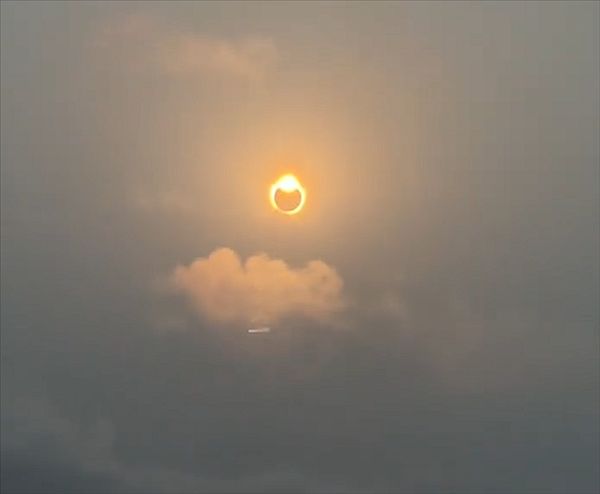
On August 12 local time, Europe witnessed its first total solar eclipse on the continent since 1999, with the moon's shadow sweeping across Greenland, Iceland, northern Spain, and a narrow strip of northeastern Portugal. Millions of astronomy enthusiasts flocked to the path of totality to witness the awe-inspiring phenomenon of daylight briefly turning to darkness.
The path of totality for this total solar eclipse was extremely narrow, and only those within this band could see the moon completely obscure the sun.
At the moment of greatest eclipse, the sun's dazzling photosphere was fully blocked by the moon, revealing the silvery-white solar corona extending outward—normally invisible to the naked eye—like a hazy, radiant "golden ring" hanging in the sky.
At the instants of second and third contact, fleeting diamond ring and Baily's beads phenomena appeared, as a burst of intense light erupted from gaps in the lunar valleys along the moon's edge, resembling a diamond set on a black disc, lasting only a few seconds.
Iceland's west coast experienced the longest duration of totality, reaching up to 2 minutes and 18 seconds. In Spain, the eclipse coincided with sunset, producing a rare "eclipsed sunset," where the sun was obscured while slowly sinking toward the horizon, blending the golden corona with evening glow in a strikingly dramatic scene.
Elsewhere across Europe, including the UK, France, Italy, and Croatia, observers could only witness partial solar eclipses of varying degrees, with the sun appearing like a crescent with a bite taken out of it.
During the total solar eclipse, temperatures within the path of totality dropped noticeably, birds returned to their nests, the sky rapidly transitioned toward dusk, and some bright stars became visible.
That day, large numbers of eclipse chasers flooded into small towns in northern Spain, where hotel rooms were nearly impossible to find, fueling an astronomy tourism boom. The Spanish government also issued special safety viewing guidelines, urging the public to wear professional eclipse glasses and strictly avoid looking directly at the sun to prevent permanent eye damage.
For mainland Europe, the last total solar eclipse occurred 27 years ago, while Spain itself had to look back a century. Astronomical records indicate that the Iberian Peninsula will experience successive total and annular solar eclipses in the coming years, making it a key region for eclipse observation in Europe.
Related Articles

Huawei phone users have finally got what they've been waiting for! The HarmonyOS trial beta version of NetEase Cloud Music is now available.
about 4 hours ago

The price after discounts is 6544 yuan! Lenovo ThinkPad E14 2026 laptop is now available: Core 5 320 + 512GB
about 5 hours ago