
Lunar infrastructure by 2035! China's lunar robot dogs will handle mining and habitat construction.
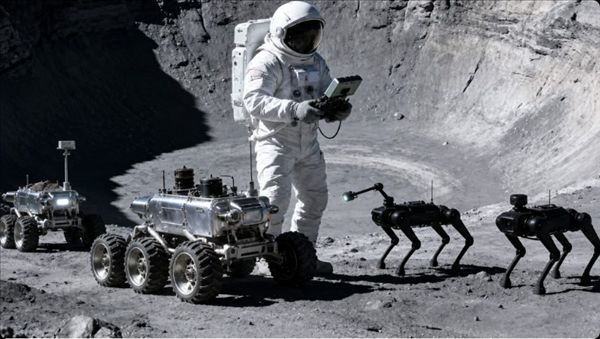
A domestic aerospace team has released a new research proposal, planning to deploy four-legged robot dogs on a future lunar base to take over heavy and dangerous tasks such as mining and assembling living modules from astronauts.
The proposal, put forward by a team from the China Academy of Aerospace Science and Technology, aims to support the International Lunar Research Station scheduled for completion in 2035.
The lunar environment is harsh, with low gravity, strong radiation, extreme temperature swings, and pervasive lunar dust, making long-term operations by astronauts alone difficult. So researchers have designed a human-machine division of labor model. Astronauts handle complex decision-making and fine operations, while robot dogs take on repetitive, high-risk physical work.
Four-legged robot dogs have clear advantages over wheeled lunar rovers—they can traverse complex terrain like craters, rubble, and lava tubes with ease, whereas wheeled vehicles are prone to getting stuck.
The standard extravehicular configuration is 3 astronauts paired with 2 robot dogs: one astronaut controls a robot dog to scout ahead and identify hazardous areas; the second collects rock samples and conducts detailed scientific work; the third remains in the pressurized cabin to coordinate all equipment.
Robot dogs are tasked with four major categories of work. First, resource extraction: searching for and excavating lunar water ice, and refining mineral materials on-site. Second, base construction: using lunar regolith to produce building materials in place, modifying lava tubes, and assembling shelters for astronauts.
On a daily basis, they also handle base inspection, monitoring air and temperature, cleaning the cabin, tending to cultivated plants, and even simple food preparation.
Beyond that, robot dogs serve a companionship function. Long-term isolation from Earth can cause psychological stress, and robot dogs can converse with astronauts to alleviate negative emotions from solitude.
The entire collaborative system is structured in four layers, covering everything from environmental perception and decision planning to execution and operation. It supports four levels of control modes, running autonomously under normal conditions and only calling for human intervention in special situations.
According to the plan, an initial lunar base will be established by 2035, with larger-scale lunar surface facilities completed by 2045.
Many netizens find the design quite futuristic. In the past, lunar robots were only responsible for photography and sampling; in the future, robot dogs will directly participate in building bases and mining resources, significantly reducing the risk for astronauts.
Currently, the proposal is still in the theoretical planning stage. Prototypes still need to undergo extensive simulation tests for radiation, extreme temperatures, and more, and there are still many technical hurdles to overcome before actual lunar deployment.
Related Articles

Huawei phone users have finally got what they've been waiting for! The HarmonyOS trial beta version of NetEase Cloud Music is now available.
about 4 hours ago

The price after discounts is 6544 yuan! Lenovo ThinkPad E14 2026 laptop is now available: Core 5 320 + 512GB
about 5 hours ago