DIY PC building is completely dead! RTX 50 series GPU pricing for China leaks: 5080 starting price at 12,000 yuan
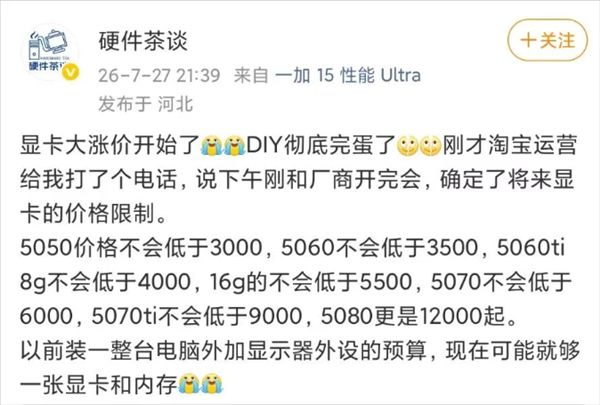
According to a post by blogger "Hardware Tea Talk," the RTX 50 series graphics card market in China is experiencing a new round of price hikes. The starting price for the RTX 5080 has reached 12,000 yuan, further raising the overall price range for graphics cards.
According to the leaked price line, the minimum channel price for the RTX 5050 is no less than 3,000 yuan, the RTX 5060 no less than 3,500 yuan, the RTX 5060 Ti 8GB version no less than 4,000 yuan, the 16GB version no less than 5,500 yuan, the RTX 5070 no less than 6,000 yuan, and the RTX 5070 Ti no less than 9,000 yuan.
Taking the RTX 5080 as an example, its previous domestic MSRP for the reference version was 8,299 yuan. Based on the leaked starting price of 12,000 yuan, this is an increase of 3,701 yuan, or approximately 44.6%. This increase clearly goes beyond what can be explained by changes in VRAM costs alone.
Currently, wholesale channel prices have already risen first, gradually moving closer to the leaked price line. According to channel data from July 27, the wholesale price of the RTX 5070 increased by 800 yuan in a single week, with the current quotation range being 5,600–5,750 yuan, just a step away from the leaked minimum price of 6,000 yuan.
The RTX 5060 Ti 16GB version increased by 600 yuan, with the current range being 4,400–4,550 yuan. The wholesale price of the RTX 5060 Ti 8GB version also rose by 400 yuan in a week, continuing to approach the leaked floor price.
According to earlier reports, NVIDIA has raised the supply prices of GPU cores and VRAM to downstream board partners, covering the entire RTX 50 series and some RTX 40 series products. This will directly increase the procurement costs for board partners.
The main models of the RTX 50 series are equipped with GDDR7 VRAM, while the RTX 5050 desktop version continues to use GDDR6 VRAM. Both types of VRAM are part of the DRAM industry chain, sharing some upstream wafer and packaging resources with regular memory.
Currently, the three major memory manufacturers—Samsung, SK Hynix, and Micron—are allocating more wafer, packaging, and testing resources to high-value HBM and server DDR5 products, leading to a relative contraction in the production capacity allocated to consumer-grade DRAM and GDDR VRAM.
According to a previous forecast by TrendForce, the sequential growth rate of traditional DRAM contract prices in the second quarter of 2026 could reach 58% to 63%. Due to suppliers continuously shifting production capacity toward the server side and cloud service providers locking in capacity in advance, consumer-grade DDR4, DDR5 memory, as well as GDDR6 and GDDR7 VRAM used in graphics cards, are all facing supply contraction and cost increase pressures.
The DIY PC building market in 2026 is entering a high-cost cycle driven by AI demand, with ordinary users facing a sharp increase in PC building costs.
Related Articles
Huawei phone users have finally got what they've been waiting for! The HarmonyOS trial beta version of NetEase Cloud Music is now available.
about 4 hours ago
The price after discounts is 6544 yuan! Lenovo ThinkPad E14 2026 laptop is now available: Core 5 320 + 512GB
about 5 hours ago