AMD: Thought it would only be a slight edge over NVIDIA, but the advantage turned out to be far bigger.
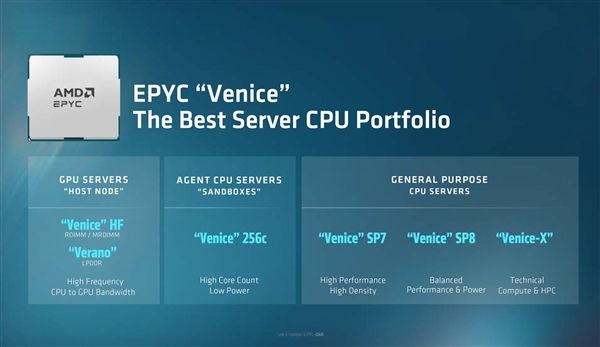
Fast Tech July 26 - At Advancing AI 2026, AMD disclosed benchmark comparison data between its Zen 6 architecture Venice processor and NVIDIA's Vera CPU using SPEC CPU 2026, claiming a lead in integer throughput and single-core performance over its competitor.
Ravi Kuppuswany, AMD's Vice President of Enterprise Solutions, stated, The company originally expected a 10% performance advantage over Vera, but actual testing revealed a 20% advantage, and this was achieved before full optimization work was completed.
AMD claimed in its slides that Venice's throughput is 2.2 times that of Vera, with single-core performance being 1.2 times faster, though these numbers warrant a closer breakdown.
In terms of throughput comparison, AMD used a 256-core 600W Epyc 9996 against an 88-core Vera, both in dual-socket configurations. It is not surprising that the Epyc, with nearly twice the core count and 150W higher TDP, has an advantage in throughput.
AMD's argument is that NVIDIA only offers a single 88-core SKU, making the comparison fair, but NVIDIA has consistently emphasized that Vera is not designed to compete with the 256-core Venice but rather as a dedicated CPU for AI workloads.
Single-core performance data is more informative. NVIDIA reported a total score of 925 for Vera, while AMD claims its 96-core high-frequency Epyc achieved 1210 points. Dividing the total score by the number of cores, AMD scores approximately 6.3, NVIDIA approximately 5.3, giving AMD a lead of about 18.8%, roughly consistent with the officially claimed 1.2x advantage.
It should be noted that the above scores are marked as "estimated," as they have not been reported to the SPEC organization and thus cannot obtain official certification.
Additionally, both AMD and NVIDIA used the GCC 15.2 compiler, but differences in compiler optimization options can also affect the final results, making it difficult to draw definitive conclusions before official scores are released.
The current comparison is limited to integer workloads, with floating-point performance yet to be disclosed. AMD holds a strong position in vectorization performance in the current server CPU market, with AVX-512 capabilities being a selling point for EPYC. In AI training and inference workloads, where matrix operations are intensive, floating-point and vector instruction performance is often more practically relevant than integer throughput.
Related Articles

Huawei phone users have finally got what they've been waiting for! The HarmonyOS trial beta version of NetEase Cloud Music is now available.
about 3 hours ago
The price after discounts is 6544 yuan! Lenovo ThinkPad E14 2026 laptop is now available: Core 5 320 + 512GB
about 4 hours ago