
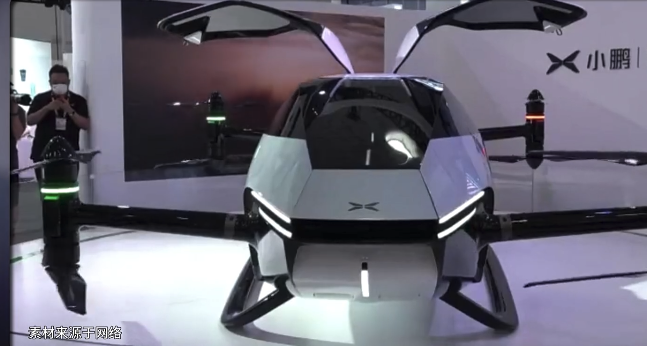
AutoHome recently released a feature video titled “Flying Cars: A Trillion-Yuan Market Ready to Explode?”, exploring the latest developments and potential of China’s flying car industry. The video highlights how flying cars are emerging as a breakthrough in integrated land-air transportation, marking the acceleration of the country’s “low-altitude economy.”
According to industry data, China’s flying car market was valued at approximately USD 17 billion in 2022 and is projected to surpass USD 30 billion by 2025. The Civil Aviation Administration of China (CAAC) forecasts that by 2035, the overall low-altitude economy could reach 3.5 trillion yuan, with flying cars playing a pivotal role.
From a technological perspective, Chinese enterprises are leveraging their strengths in electrification, lightweight materials, and intelligent flight control systems to gain an edge in the global eVTOL race. Manufacturers are advancing rapidly in areas such as high-density batteries, vertical takeoff and landing systems, and autonomous navigation, creating a more complete industrial ecosystem.
In terms of applications, flying cars are currently being deployed in government and enterprise scenarios such as emergency response, logistics, and aerial inspection. As technology and regulations mature, consumer-facing markets—such as urban air taxis, short-range commuting, and sightseeing—are expected to emerge. The AutoHome video noted that a typical one-hour car commute could be reduced to just 20 minutes by air, showcasing the practical potential of urban aerial mobility.
However, significant challenges remain before flying cars can achieve large-scale adoption. Airspace management, safety certification, infrastructure development, and business models all require coordinated progress. Industry experts emphasize that the pace of policy support and regulatory frameworks will determine the speed of commercialization.
With growing investment and government backing, China’s flying car industry is transitioning from prototype testing to early-stage commercialization. Over the next decade, urban commuting, low-altitude logistics, and tourism are expected to be the first viable use cases. Flying cars are also being viewed as a representative force in advancing China’s “new quality productive forces.”
Conclusion:
From “able to fly” to “ready to use,” flying cars are turning science fiction into reality. As policy frameworks solidify and technology matures, China’s flying car market is poised to accelerate along the fast lane of the low-altitude economy. Those who master both the technology and business models of aerial mobility may define the next global revolution in transportation