
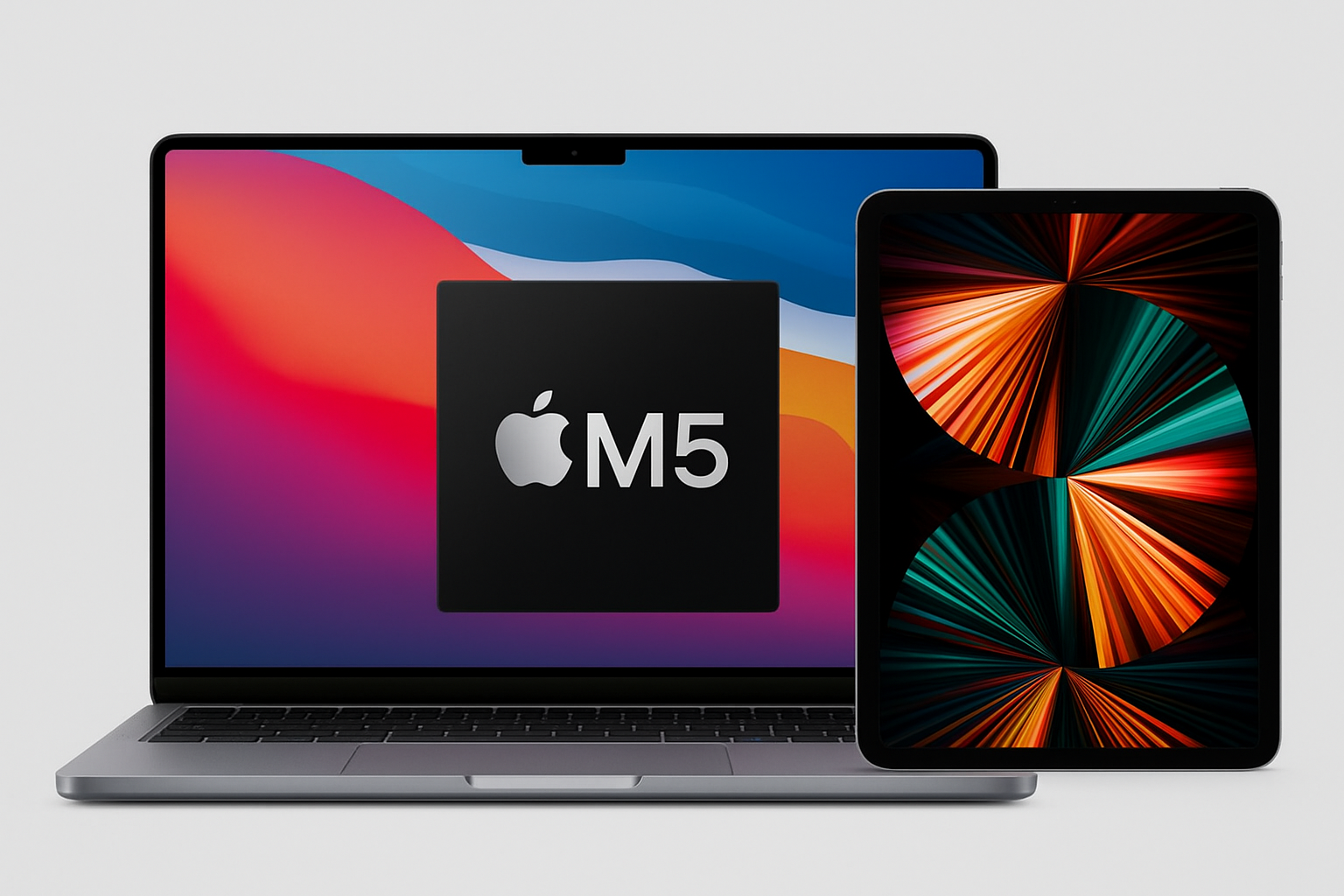
Apple’s latest M5-powered MacBook Pro and iPad Pro are setting new performance benchmarks, according to a comprehensive review released by Phoenix Tech. Built on a 3-nanometer process, the Apple M5 chip combines higher computational power, improved graphics processing, and cutting-edge on-device AI capabilities that further blur the line between professional workstations and portable devices.
“The M5 is not just a speed upgrade — it’s a structural leap in AI computing,” said a Phoenix Tech analyst. “Apple has successfully embedded neural acceleration into every GPU core, enabling real-time, on-device AI processing without relying on cloud resources.”
Key Specifications and Benchmark Results
| Category | MacBook Pro (14″ M5) | iPad Pro (M5) |
|---|---|---|
| CPU Architecture | 10 cores (4 performance + 6 efficiency) | 10 cores (4 + 6) |
| Unified Memory Bandwidth | Up to 153 GB/s (+30% vs M4) | Similar bandwidth |
| GPU + Neural Engine | New GPU architecture with neural accelerator per core | Same configuration |
| Geekbench 6 Scores | Single-core ≈ 4,263 / Multi-core ≈ 17,862 | Multi-core ≈ 16,366 |
| Gaming (Cyberpunk 2077) | 30 FPS default / 60 FPS with FSR enabled | — |
| AI Workload (DeepSeek-R1 8B) | Comparable to M1 Max 24-core with lower power draw | — |
| Network / Modem | — | New C1X modem with faster 5G speed and stability |
| Battery Life | Up to 24 hours / 50% charge in 30 min | 50% charge in 30 min |
| Thermal Performance | Low fan noise / stable under load | Efficient heat control without throttling |
Real-World Performance
In tests, the M5 MacBook Pro delivered desktop-class performance across creative workloads. Rendering, 3D modeling, and AI-enhanced video editing ran smoothly with improved energy control. Gaming results were particularly notable: Cyberpunk 2077 maintained a stable 30 FPS on default settings and reached 60 FPS when frame generation was enabled — a first for Apple’s notebook lineup.
For AI applications, local inference on models such as DeepSeek-R1 (8B parameters) ran efficiently and quietly, showing how the M5’s redesigned Neural Engine can handle tasks previously reserved for cloud-based computation.
The iPad Pro’s upgrade focuses on connectivity and portability. The newly integrated C1X modem offers faster 5G throughput and more stable signal performance, making it ideal for creators who rely on constant network access. While the exterior design remains unchanged, internal enhancements make it Apple’s most powerful tablet yet.
Advantages and Limitations
Advantages
- Substantial boost in AI and GPU performance
- Improved energy efficiency and heat management
- Long battery life with fast-charging support
- Enhanced 5G speed and stability on iPad Pro
Limitations
- Minimal external design changes
- Marginal gains for M4 owners
- Premium pricing, especially for MacBook Pro models
Who Should Upgrade?
Phoenix Tech concludes that users of M1 or earlier devices will experience a significant leap in both responsiveness and productivity. Professionals working in video editing, 3D rendering, or AI development will find the M5 MacBook Pro a powerful yet portable workstation.
Meanwhile, the iPad Pro M5 targets digital artists, content creators, and mobile professionals seeking laptop-level performance in a lightweight design. However, owners of M4-based devices focused on everyday productivity may not find the performance gain compelling enough to justify an upgrade.
Industry Context
Apple’s M-series journey began with the M1 chip in 2020, marking the company’s transition from Intel processors to in-house silicon. Each generation has expanded Apple’s control over its ecosystem, and the M5 pushes this evolution into the era of AI-driven computing. The integration of per-core neural acceleration reflects the broader industry trend toward edge AI — processing intelligence locally rather than in the cloud.
“This generation positions Apple not only as a hardware leader but as a platform for the next phase of creative and AI-powered workflows,” the review concluded.
Conclusion
With the M5, Apple continues to redefine mobile performance standards. While the physical design may remain familiar, the new architecture delivers a deep leap in power efficiency, graphics capabilities, and machine-learning intelligence. Together, the MacBook Pro M5 and iPad Pro M5 signal Apple’s clear commitment to building devices ready for the AI-first era.