US crackdown on AI chips for China backfires, foreigners worry two worst-case scenarios are imminent
The most talked-about large model globally over the past week wasn't from OpenAI or Anthropic, but Ox-Alpha, which has now been confirmed to be Zhipu's GLM-5.3 Flash.
GLM-5.3 Flash not only ranks among the top globally in AI performance, but the more significant change behind it is that Zhipu provided ample computing resources this time, with up to 100T of daily token support during the free period. Although actual traffic didn't reach that level, it still shows Zhipu's confidence in its computing resources.
Now that this information has been declassified, Zhipu confirmed the use of tens of thousands of domestic chips, without disclosing specific models or specifications. However, Zhipu founder Tang Jie briefly introduced their team's optimization process for domestic chips.
Ultimately, compared to the initial baseline on the same hardware, end-to-end service performance improved by 3 times, with hardware efficiency and per-token costs now approaching mainstream NVIDIA GPUs.
Domestic chips can now economically and efficiently support inference for cutting-edge models at scale. The price is 1/100 of cutting-edge alternatives, while efficiency is on par with mainstream GPUs.
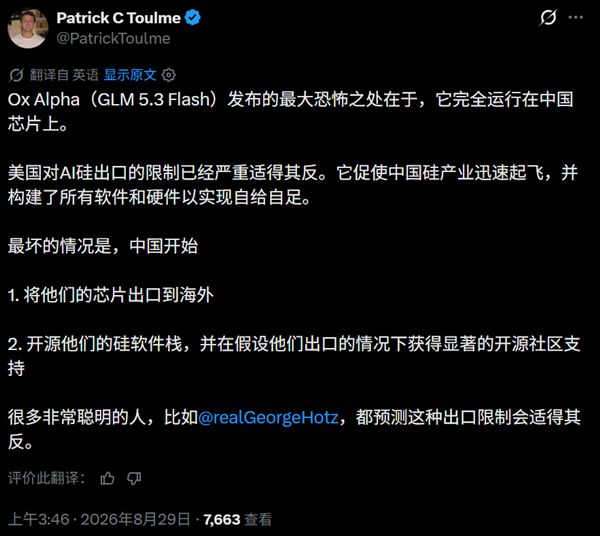
The joint optimization of GLM-5.3 Flash with domestic chips is highly significant, and even foreigners have noticed the trend it represents, pointing out that the U.S. policy of blocking AI chip exports to China over the past few years has severely backfired, instead accelerating the rapid rise of China's chip industry and driving the construction of a fully self-sufficient software and hardware ecosystem.
He also predicted the worst-case scenarios: one being China exporting AI chips overseas, and the other being open-sourcing the software stack and gaining support from the open-source community.
His concerns actually mirror the previous stance of NVIDIA founder Jensen Huang, who opposed a complete ban on AI chip exports, emphasizing the importance of keeping China's tech industry dependent on U.S. technology. He argued that completely cutting off AI chip and large model exports would instead push China's AI industry toward independence, from large models to chips, building its own technology ecosystem to compete with American companies.
It's worth noting that in electric vehicles, batteries, solar, and other high-tech industries, the efficiency and price advantages of Chinese companies have already made it difficult for European and American companies to compete directly. Jensen Huang worries that the AI industry will face the same scenario in the future.
Related Articles

Huawei phone users have finally got what they've been waiting for! The HarmonyOS trial beta version of NetEase Cloud Music is now available.
about 2 hours ago
The price after discounts is 6544 yuan! Lenovo ThinkPad E14 2026 laptop is now available: Core 5 320 + 512GB
about 4 hours ago