Tested the official release of DeepSeek V4 Pro, which now completes its Agent capabilities.
No announcement, no countdown, not even a changelog ready in time. The official release of DeepSeek V4 Pro just arrived, quietly.
In the early hours of the morning, the DeepSeek website silently refreshed its API documentation. The model name was still deepseek-v4-pro, but the fingerprint had changed to fp_v4pro_20260812. A glance at the community showed the news had already exploded—V4 Pro official version, here it is.
Counting from the preview release on April 24, that's a full 111 days.
During that time, Kimi K3's high-profile launch stole the open-source spotlight, the V4 Flash official version went live ahead of schedule on July 31, and the API price hike notice hung over every developer's head.
Everyone was asking the same question: when exactly would the Pro official version arrive?
The answer came on a Wednesday night.
01 Architecture unchanged, capabilities skyrocketed
Let's start with the hard specs. The V4 Pro official version's model architecture is identical to the preview—1.6T total parameters, 49B activated parameters in a MoE structure, supporting 1M context and 384K maximum output. What changed is the post-training, and the change is so significant it feels like a different model.
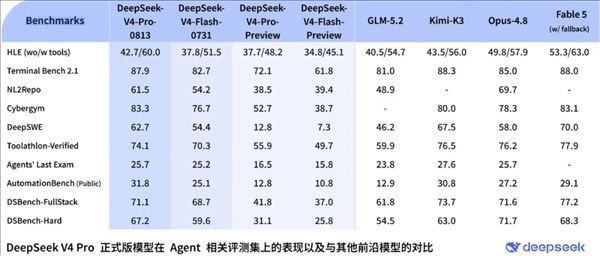
The most striking numbers come from Agent-related benchmarks. DeepSWE (DeepSeek's own software engineering benchmark) jumped from 12.8 in the preview to 62.7—a nearly 50-point leap. Cybergym went from 52.7 to 83.3, Terminal Bench from 72.1 to 87.9, and DSBench-Hard more than doubled to 67.2.
These test items share one common trait—they all involve long-chain code modifications, environment operations, and tool calls. Precisely the areas where the preview version was most prone to failure.
DeepSeek V4 Pro official version shows significantly enhanced Agent capabilities | Image source: DeepSeek
From the V4 Flash official version's changelog, it can be inferred that the core of this upgrade is large-scale post-training targeting code Agent scenarios. The Flash version already used the same approach to push Agent capabilities to a level where "benchmark scores far exceed V4-Pro-Preview," and the Pro version simply completed the same lesson.
On pricing, input costs 3 yuan per million tokens and output costs 6 yuan, unchanged from the preview.
Although DeepSeek already announced on August 6 that it "plans to raise API pricing overall in the near term, with an expected significant increase," the 0813 version hasn't changed yet. How long the window lasts is uncertain—if you want to take advantage, do it early.
02 Ceiling and temperament
Good benchmark scores are just the ticket; what really matters is testing with real tasks.
GeekPark ran three different tests on the V4 Pro official version, trying to answer one question—how far has this model come in "generating complete, runnable code in a single pass"?
The first task was a Boids flocking emergence simulation. It required implementing flocking behavior for 200 triangular boids on Canvas, with three adjustable parameters for separation/alignment/cohesion, colored trails, click-to-spawn predators, and a glassmorphism-style control panel. This is a comprehensive task involving physics simulation, real-time rendering, and UI design.
V4 Pro took about 170 seconds to generate 761 lines of complete HTML. Opening the browser, 200 colored triangles swam, clustered, and avoided obstacles against a black background, with sliders allowing real-time adjustment of flocking behavior patterns. The effect was smooth, and the code ran successfully on the first try.
The second task was deliberately vague—told in Chinese, "I want a nice-looking Pomodoro work panel," with only the directions "can time, can record, has white noise, Chinese interface, should feel premium," leaving the rest to the model's discretion.
V4 Pro delivered 1,223 lines of code. Beyond the basic 25/5-minute timer functionality, it added task tags, focus statistics charts, keyboard shortcuts, and even synthesized several white noise options from scratch using the Web Audio API.
Its ability to "productize and fill in gaps" for vague requirements is a clear improvement over the preview version.
The third task was pathfinding algorithm visualization, requiring step-by-step animations for BFS, DFS, and A* algorithms, an interactive grid for drawing walls, and automatic maze generation. This task had the largest code volume and was also where it failed the most—but the way it failed was itself quite interesting.
With the default thinking mode enabled, V4 Pro used its 16,384-token output quota, with 13,394 tokens spent on "thinking." Fewer than 3,000 tokens were left for actual code, which got truncated directly—the HTML was cut off mid-write.
Rerunning with thinking mode off, it output the complete 715 lines of code in 54 seconds, with pathfinding animations, maze generation, and dark theme all fully included.
This isn't a bug, but a genuine characteristic of the V4 Pro official version—in complex code generation scenarios, thinking mode's reasoning tokens can account for over 80% of output, squeezing out space for actual content.
For tasks requiring large code outputs, developers may need to proactively disable thinking, or significantly raise max_tokens as a safety net.
03 The big whale's position
After hands-on API testing, frankly speaking, V4 Pro 0813 isn't a report card of "dominating across the board."
Without tools, HLE scores 42.7, trailing Claude Opus 4.8's 49.8 and Fable 5's 53.3. NL2Repo scores 61.5, behind Opus 4.8's 69.7. With Kimi K3 in the picture, it also shows slight gaps on some tests.
For pure knowledge reasoning and the most complex software engineering tasks, V4 Pro hasn't yet claimed the top spot.
But DeepSeek has never won by being "the strongest." It wins through that law everyone can recite—anything stronger than me costs more; anything cheaper than me isn't as strong.
At 3 yuan per million input tokens, the price is roughly one-tenth of Fable 5 and one-third of Kimi K3.
Now that Agent capabilities have surged from "almost unusable" to "able to go head-to-head with top closed-source models," the lethality of this law is an order of magnitude greater than during the preview period.
Even more noteworthy is a small line buried in the V4 Flash official version's changelog—the evaluation used "DeepSeek Harness minimal mode (coming soon)" as the Agent framework. Combined with the "DeepSeek Harness team" official account registered a couple of days ago and earlier recruitment postings, DeepSeek is preparing to package and launch the model together with an Agent runtime framework.
If past competition was about "whose model is smarter," the arrival of Harness signals the competition formally entering the next phase—not about whose brain is better, but about who can assemble a brain, hands, and toolbox into a system that genuinely does work for people.
The V4 Pro official version has filled in the brain piece. Next, we'll see how long that "coming soon" takes.
Related Articles

Huawei phone users have finally got what they've been waiting for! The HarmonyOS trial beta version of NetEase Cloud Music is now available.
about 4 hours ago
The price after discounts is 6544 yuan! Lenovo ThinkPad E14 2026 laptop is now available: Core 5 320 + 512GB
about 5 hours ago