
NASA Releases High-Resolution Photos of SpaceX Rocket Debris Crashing into the Moon, Butterfly-Shaped Streaks Appear in Impact Crater
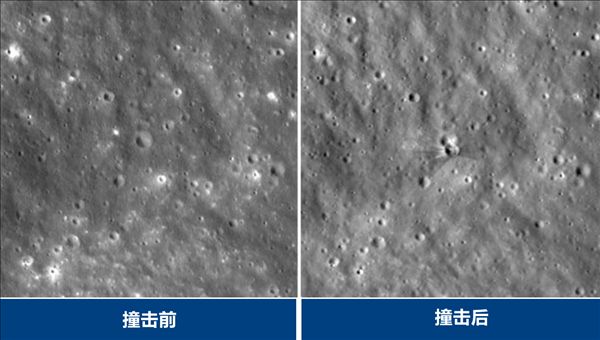
According to the Associated Press, NASA released the latest images captured by the Lunar Reconnaissance Orbiter (LRO) on August 18, clearly showing a fresh crater left by the impact of a SpaceX Falcon 9 rocket's second stage on the lunar surface.
The impact crater measures approximately 18 meters in diameter and about 3 meters deep, with bright and dark streaks resembling butterfly wings radiating from its surroundings.
The rocket's second stage struck the lunar surface at 6:35 UTC on August 5 at a speed of 2.43 kilometers per second, with an impact force equivalent to nearly 3 tons of TNT. The impact site is located near the Einstein crater on the near side of the Moon.
Because the LRO had to wait six days for its orbit to align before flying over the impact site, plus subsequent image processing time, NASA only recently released these high-definition photos.
The images show streaks extending outward from the crater in a butterfly-wing pattern. The darker portions are surface material that has undergone long-term space weathering, bombarded by solar wind, cosmic rays, and micrometeorites; the brighter portions are fresh rock and soil ejected from depth, which have higher reflectivity.
The LRO captured these images from an altitude of 96 kilometers, with flight controllers specifically adjusting the spacecraft's orientation to aim its camera at the impact area.
The Falcon 9 second stage had a rather eventful history. It launched from Florida in January 2025, tasked with delivering two commercial lunar landers—Firefly Aerospace's Blue Ghost and Japan's ispace Resilience (Hakuto-R M2 mission)—as part of NASA's Commercial Lunar Payload Services program.
After completing payload deployment, the discarded rocket's second stage drifted in space for over a year before striking the Moon at approximately 8,700 kilometers per hour. Although no one directly observed the moment of impact, a telescope in Chile captured the debris plume generated by the collision.
Notably, South Korea's Danuri lunar orbiter was the first to fly over the area after the impact and transmitted initial images, with the LRO subsequently providing higher-resolution photos. The LRO has been orbiting the Moon since 2009, serving as NASA's "eye in the sky" for close-up lunar observation.
Related Articles

Huawei phone users have finally got what they've been waiting for! The HarmonyOS trial beta version of NetEase Cloud Music is now available.
about 4 hours ago

The price after discounts is 6544 yuan! Lenovo ThinkPad E14 2026 laptop is now available: Core 5 320 + 512GB
about 5 hours ago