Headphone market sales plummet! Huawei bucks the trend: StarFlash achieves wireless Hi-Fi lossless
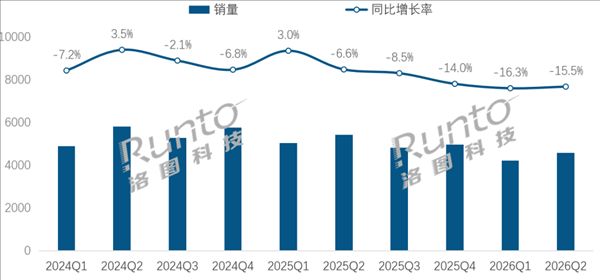
According to the latest research report from Luo Tu Technology, the domestic headphone industry has long passed the growth dividend brought by TWS wireless replacement. From 2018 to 2023, the industry continued to expand. Now, TWS penetration has peaked, headphone lifespan has increased, and user replacement cycles have significantly lengthened. In 2025, annual headphone sales declined for the first time, and the industry has officially entered a phase of inventory adjustment.
In the first half of 2026, domestic headphone sales across all channels reached 87.97 million units, a year-on-year decline of 15.9%, with total revenue of 20.4 billion yuan, down 12.4% year-on-year. The market decline has further widened compared to last year.
Institutions forecast that full-year headphone sales will be only 180 million units, a year-on-year decline of about 10.8%. Saturated demand, high product homogeneity, and consumers' low willingness to upgrade are the core reasons for the industry's pressure. Relying solely on traditional Bluetooth hardware parameter upgrades is unlikely to drive a market recovery.
Consumer survey data indicates that 68% of users report that ordinary wireless headphone transmission causes significant sound quality loss, which is also a key factor deterring them from upgrading their headphones.
Currently, streaming platforms are releasing a large number of high-spec lossless audio sources, but traditional Bluetooth has inherent bandwidth limitations. The mainstream solution has a maximum bitrate of only 990kbps, falling short of the 2.3Mbps transmission standard required for Hi-Fi lossless audio. High-resolution audio must be compressed during transmission, meaning wireless headphones can never match the full listening experience of wired Hi-Fi. This is a long-standing technical pain point that the industry has failed to resolve.
StarFlash Nearlink achieves a complete innovation at the underlying architecture level, with a physical layer maximum transmission speed of up to 16Mbps. This ample bandwidth can stably carry 48kHz/24bit Hi-Fi lossless audio sources and even support higher-spec 96kHz/24bit audio, completely avoiding the sound quality loss caused by transmission compression.
In addition, StarFlash also offers advantages such as low latency, stable connections, and multi-device synchronization, breaking the traditional notion that lossless sound quality can only be achieved with wired headphones and reshaping the standard for wireless audio transmission.

Domestic lossless audio standards define two levels: CD lossless and Hi-Fi lossless. In the past, the vast majority of wireless devices could not meet the transmission threshold for high-end Hi-Fi lossless. However, headphones equipped with StarFlash technology can fully reproduce high-resolution audio details, meeting the demands of music enthusiasts for lossless sound quality.
Currently, the Huawei FreeBuds Pro5 and FreeClip 2 are benchmark StarFlash headphone products. Leveraging proprietary audio technology, they have formed a unique competitive edge, achieving counter-trend growth in a shrinking overall market.
In the first half of 2026, Huawei's domestic headphone market share by revenue exceeded 20%, up 4.6 percentage points year-on-year. The brand's new sales volume largely came from these two StarFlash models, directly proving that this new technology has strong market appeal.

From an industry data perspective, Luo Tu Technology is optimistic about the StarFlash headphone niche. It estimates that domestic StarFlash headphone shipments will exceed 20 million units in 2026, with a market penetration rate of over 10%.
StarFlash has filled the differentiation gap in existing wireless headphones. As more brands follow suit and penetration continues to rise, it is expected to become the core driver for the next round of growth in the headphone market.
Related Articles
Huawei phone users have finally got what they've been waiting for! The HarmonyOS trial beta version of NetEase Cloud Music is now available.
about 4 hours ago
The price after discounts is 6544 yuan! Lenovo ThinkPad E14 2026 laptop is now available: Core 5 320 + 512GB
about 5 hours ago