DeepSeek Harness Real-World Test: 50,000 Stars Overnight, the Android of the Agent World Arrives
At 8:30 PM on August 13, DeepSeek officially unveiled its first Agent product since its founding—the highly anticipated Deepseek Harness, which had been teased for quite some time.
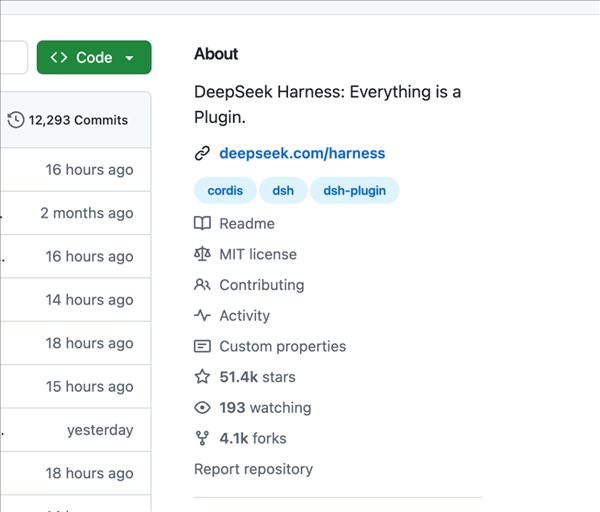
As of this writing, its GitHub repository has surged past 50,000 stars—just 12 hours after going public.
Deepseek Harness GitHub page had already surpassed 50,000 stars at the time of writing | Image source: GitHub
DeepSeek's official definition of it is largely the same as others': a model plus a Harness equals an Agent. The model is the brain, the Harness is the hands and feet; a chatbot delivers a paragraph, an Agent delivers a completed task.
On launch night, we installed it on our own computer and gave it two tasks: redesign GeekPark's official website in The Verge's style, and pull GitHub's API to chart its own star-growth curve. Both tasks were delivered, with total token costs under 3 RMB.
But it's still rough around the edges: the interface isn't friendly to non-coders, and the developer preview we uploaded shows rough patches everywhere. After 12 hours of use, our impression is—DeepSeek isn't trying to hand you a finished product right now; it's giving you a pile of parts waiting for you to assemble.
01 "Everything is a plugin"
The GitHub repo went public quietly half an hour before the official announcement, and here's what we watched unfold: at 21:05 it had 7,283 stars; at 21:51, 15,530. Within two hours of the announcement, stars broke 10,000; by this morning, it had surpassed 50,000.
For context, OpenClaw—dubbed the fastest-growing repo ever—gained 200,000 stars in 84 days, roughly 99 per hour. DSH's pace in its first two hours was 80 times that.
Deepseek Harness isn't a cloud service yet: on a machine with Node.js installed, typing "npx @deepseek-ai/dsh web" and opening local port 3080 in a browser is its entire interface. Sessions, logs, and data all stay local; the browser is just its shell.
The new session page displays its slogan: "探索未至之境," with the English original "Into the Unknown," alongside a "Preview" badge. On first launch, an "internal test notice" pops up, roughly saying version 0.1 is still being tested with Harness developers, and core plugins and basic interfaces will evolve rapidly in the coming months. Translation: this is a developer's taste, not a finished product for regular users.
Its most radical—and most controversial in the 12 hours since release—design is "everything is a plugin."
The plugin concept is core to Deepseek Harness | Image source: GeekPark
Models, tools, interfaces, approval policies, even the main loop driving the entire Agent—all of it can be swapped out: if you want, even the entire frontend can be replaced with a style you prefer. For instance, right off the bat, I used a prompt to change it to a magenta theme I like better.
DeepSeek lets you freely modify various components, including the Web UI frontend | Image source: GeekPark
This small detail—letting you directly modify Harness's Web frontend—actually reveals the development logic of Deepseek Harness: it's an ecosystem built from plugins of all sizes; as long as you're willing to adapt to this system, you can assemble a unique work ecosystem tailored to you.
Per official docs, Deepseek Harness comes with four presets: Standard, Minimal, Code, and Creative. The official evaluation that had V4-Flash topping Terminal Bench last month used the Minimal mode—the "upcoming DeepSeek Harness" mentioned in the API changelog at the time was fulfilled yesterday.
Deepseek Harness currently includes 4 preset Agent modes, and you can also manually add your own presets | Image source: GeekPark
The openness paid off faster than expected. Developers in the beta phase built around 300 plugins in a few days—some gave it a retro Windows XP skin, others made an emoji plugin that sends you a big fat fish meme after finishing a task. But this breadth of play exactly shows: nothing in this framework is welded shut.
But as fast as stars climbed, the cold water came just as quickly. The day after release, developer community opinions began to diverge: whether it's Deepseek Harness's current user experience being unfriendly to non-programmers, or the entire plugin-centric ecosystem around it, both sparked controversy and discussion.
None of that cold water was aimed at the model—all of it hit the Harness "shell." How good is that shell? Our two tests on launch night are a good reference point.
After getting hands-on with Harness, my first test was having it redesign GeekPark's official website: I threw the GeekPark URL at it and asked it to create a new site design in The Verge's style.
This task tested another pitfall: whether it would actually look at both websites.
This is the actual result Deepseek Harness produced: the site's formatting and interactions had some minor issues, but once you install more model- and design-focused Agent capability plugins through Deepseek Harness's plugin architecture, the whole site rapidly iterates into something more modern.
For example: although Deepseek Harness doesn't have a built-in canvas feature, you can add one via plugins; the official plugin library has a ready-made one called DSH-OpenPencil. After installing it, you can preview interaction design files in real time within the conversation, turning Deepseek Harness's otherwise plain Web UI into a design delivery tool.
Additionally, to verify its image generation and data extraction capabilities this time, I even used Deepseek Harness to directly generate a GitHub growth trend chart from last night to this morning:
Prompt: Use GitHub's public API to check the star data for the deepseek-ai/deepseek-harness repo, combined with these manually recorded time points: August 13 21:05 was 7,283, 21:51 was 15,530, August 14 8:53 was 44,514. Draw a star growth curve chart, x-axis time, y-axis star count, label key points, save as an image.
DeepSeek Harness has a "Trajectory" page where everything the model sees is logged: system prompts, chain of thought, every tool call and its result. So whether it truly scraped the page or "imagined" a Verge style from training memory can be verified by checking the logs. This "full traceability" is one of the fundamental architectural differences from chatbots—chat tools only save the final conversation; it saves every step of the process.
This design also earned its loudest praise on Hacker News. One developer called the "append-only log of everything the model sees" a killer feature, specifically noting that US model vendors' APIs hide exactly this layer of data.
Crunching the numbers
Harness itself is free and open source, but model calls are still billed as usual: everything we tested used the pre-price-hike model rates from the 13th, so it's still plenty generous—in fact, across all the demos in this entire article, our total token consumption stayed under 3 RMB.
Additionally, Deepseek Harness proactively lays out the costs for you: each session has real-time stats at the bottom—how many steps this round, model latency in seconds, input/output tokens, even cache hit rate—all laid bare.
And that's exactly where the controversy lies.
The day after release, a third-party comparison circulating in developer circles claimed that the same V4-Flash connected to another open-source harness, Pi, consumed only about a third of the tokens DeepSeek Harness did.
In our own experience, aside from V4 Pro Max still being generous, directly using Deepseek V4 Flash is not only faster but also doesn't drop much in content generation accuracy. Perhaps this also signals that Deepseek's Harness is genuinely still in developer preview—it's not the final version.
02 The Android of the Agent world
DeepSeek isn't the first model company to build its own "shell." Anthropic has Claude Code, OpenAI has Codex, and now the last major player has joined the list.
Harness may be one of the most important paths for large models to break into production scenarios; developer tool company Composio ran a comparison test: the same V4-Flash, connected to eight different harnesses, completing thirty tasks. The best finished twenty, the worst only fourteen. Identical model, results differing by 30%.
The model sets the ceiling of capability; the Harness determines how much of that capability is ultimately realized.
For DeepSeek, this shell also carries three more practical stakes. On cost: how context is organized and how caches hit determine how many tokens a task burns and how many retries it needs—all of this happens at the Harness layer, and other people's shells are beyond its control. On data: complete records of failed tasks are the best fuel for improving the model, and those records sit in the shell's hands. On ecosystem: as reported by NetEase Tech, the team said it would offer API credits to some developers—the intent to keep plugin developers in its own yard isn't exactly subtle.
Stepping back, over the past two years, model companies sold tokens, charging by the word, like selling water. Starting with Claude Code, they've gradually realized the real value lies in the act of "getting things done" itself. DeepSeek is the latest major player to enter, and the first to open-source the entire shell.
It's betting on a different path: others sell you a finished Agent; it lays out all the Agent's parts and bets developers will assemble them into something it never imagined.
Looking back, "feels like a framework, not a finished product"—today's biggest criticism of DeepSeek Harness—is a compliment in another frame of reference: when Android first launched, it was also a rough, unfinished thing—crude, open, appealing only to tinkerers. What happened next, everyone knows.
DeepSeek is betting that the Agent industry also needs an Android.
Related Articles

Huawei phone users have finally got what they've been waiting for! The HarmonyOS trial beta version of NetEase Cloud Music is now available.
about 4 hours ago

The price after discounts is 6544 yuan! Lenovo ThinkPad E14 2026 laptop is now available: Core 5 320 + 512GB
about 5 hours ago