Huawei's new Kirin CPU announced! Performance increased by 23%: Debuts on Huawei's lightest laptop ever.
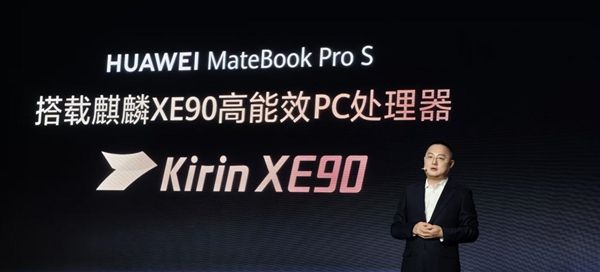
Huawei has announced two new Kirin CPUs at once!
At today's HarmonyOS PC new product technical briefing, Huawei officially announced two new processors: the Kirin X90 Plus and the Kirin XE90.

Among them, the Kirin XE90 is positioned as a high-efficiency PC processor, and will be first launched in Huawei's lightest notebook, the MateBook Pro S. Officials stated that compared to the Kirin X90, its single-core performance is improved by 23%, energy efficiency by 25%, and NPU computing power by 40%.

With a new ceramic composite heat dissipation package and substrate micro-porous thermal conductivity technology, the chip's self-cooling capability is improved by 70%, and the overall performance release reaches 20W.
The other Kirin X90 Plus is positioned as a high-performance PC processor, complementing the XE90, and will be first launched in the foldable computer MateBook Fold Ultimate. Specific specifications have not been announced yet, but officials stated that through software, hardware, core, and cloud synergy, overall performance can be improved by 25%.

For reference, the original Kirin X90 uses a 4+4+2 architecture, 10 cores and 20 threads, supports hyper-threading, with a maximum main frequency of 4.2GHz, an integrated self-developed GPU, a dual Da Vinci architecture NPU, and AI computing power of 40 TOPS. It was previously equipped in the MateBook Pro.
Now let's look at the two new notebooks announced today. The Huawei MateBook Pro S is the first to be equipped with the Kirin XE90, with a total weight of only 798g and a thickness of only 11.9mm, making it the world's lightest 14-inch all-metal notebook.

The ability to achieve such a thin and light level is inseparable from Huawei's Yun Sun architecture's breakthroughs in materials, process, and design. In materials, magnesium-lithium alloy is introduced, with a density of only 1.5g/cm³, reducing weight by 25% and thickness by 17%. It also uses the industry's first vacuum sputtering process to solve the corrosion resistance and surface treatment problems of magnesium-lithium alloy.


In terms of process, copper-steel composite VC reduces weight by 17g, ultra-thin second-strength CG cover reduces weight by 6g, heat dissipation fins reduce weight by 6.2g, composite material speaker reduces weight by 4g, ultra-thin high-strength aluminum keyboard reduces weight by 6g, and screen driver board reduces weight by 3g.

The design is even more noteworthy, introducing the concept of ancient Chinese architecture into the notebook. For the first time, a mortise and tenon integrated structure is adopted, achieving a clean design without screws on the exterior, with deformation resistance improved by 500%.


The battery uses the industry's first 10% high-silicon battery, with energy density increased by 15% and weight reduced by 10%. It can play 1080P video continuously for over 18 hours, supports left and right dual 66W reverse super fast charging, and can provide emergency power to mobile phones and tablets in power-on, power-off, and standby states.


In terms of connectivity, it is the world's first thin and light notebook with Wi-Fi 7+ and four antennas, supporting ultra-long-distance networking at the 1000-meter level. Memory options cover 16GB, 24GB, 32GB, and storage is available in 512GB and 1TB.


The MateBook Fold Ultimate will feature the Kirin X90 Plus, with a thickness of only 7.3mm when unfolded and a weight of only 1.16kg.
It uses an 18-inch world's largest dual-layer OLED flexible screen, with a 92% screen-to-body ratio, supports 1600nits HDR peak brightness, 3.3K resolution, 2,000,000:1 contrast ratio, and P3 wide color gamut adaptive color management.

The screen also uses the world's largest UTG non-Newtonian fluid toughened laminate, the industry's first non-Newtonian fluid UTG composite structure, with impact resistance improved by 90% and bending deformation resistance improved by 10 times. It has obtained the world's first SGS Gold Standard five-star full-screen anti-drop impact certification.


In terms of interaction, it supports two modes: dual-screen convenient recording and large-screen immersive creation. It also supports a stylus for global annotation, write immediately when lifting the pen, and Xiaoyi selection, combined with the boundless notes of the Huawei Notes app and the 18-inch super-large canvas of the Tiansheng Hui Hua app.
These two laptops will be officially released, when more details will be announced.
In addition, Huawei also announced that the number of applications in the HarmonyOS PC ecosystem has exceeded 19,000, covering core scenarios such as office, entertainment, creation, and gaming, with over 1,700 general peripheral devices such as keyboards and mice, and over 1,600 professional devices such as printers and scanners.


Zhu Dongdong, President of Huawei's Terminal BG Tablet and PC Product Line, stated that they will rely on the unified base of the HarmonyOS system to cover all user scenarios, with products including HarmonyOS tablets, HarmonyOS commercial tablets, HarmonyOS PCs, and HarmonyOS commercial PCs.
Related Articles
Huawei phone users have finally got what they've been waiting for! The HarmonyOS trial beta version of NetEase Cloud Music is now available.
about 4 hours ago
The price after discounts is 6544 yuan! Lenovo ThinkPad E14 2026 laptop is now available: Core 5 320 + 512GB
about 5 hours ago