Third-generation relay satellite launched! Tianlian-3 01 satellite successfully launched.
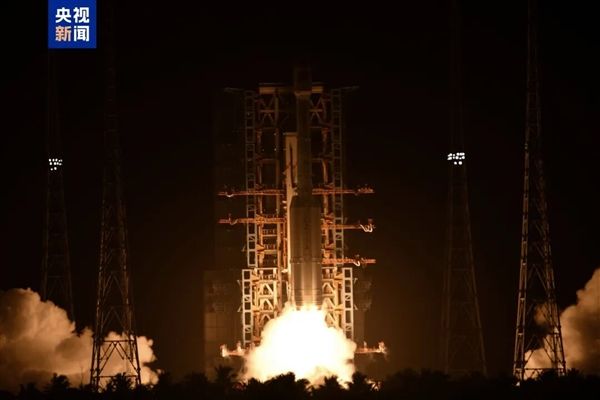
At 19:50 tonight, the Tianlian-3 01 satellite was launched aboard a Long March 7 modified rocket from the Hainan Wenchang Launch Site. The satellite successfully entered its preset orbit, marking the complete success of this launch mission.
This satellite, developed by the China Aerospace Science and Technology Corporation's Fifth Academy, is the first model of China's third-generation relay satellite.
It is primarily used to provide data relay and tracking, telemetry, and command (TT&C) services for crewed spacecraft such as spacecraft and space stations, as well as for medium and low Earth orbit resource satellites.
Many may wonder what the role of a relay satellite is. Simply put, it acts as a super signal relay station floating in space.
When a space station or crewed spacecraft orbits the Earth and moves beyond the view of ground tracking stations, signals can be lost. The Tianlian satellite bridges communication, ensuring uninterrupted contact between astronauts and the ground, and enabling real-time transmission of various space experiment data back to Earth.
In addition to crewed spacecraft, medium and low Earth orbit remote sensing resource satellites also rely on it to transmit captured image data.
Compared to the previous two generations of Tianlian satellites, this new satellite features a comprehensive hardware upgrade. It uses the enhanced Dongfanghong-4 platform with greater carrying capacity, paired with a new communication payload, allowing it to simultaneously connect with more spacecraft and significantly improving its multi-channel data parallel transmission capability.
The China Academy of Space Technology stated that the development cycle for this Tianlian-3 satellite was tight and the technical challenges were substantial.
The satellite development team, on one hand, gathered key personnel to tackle critical technical hurdles, ensuring a thorough understanding of the technologies. On the other hand, facing the heavy pressure of multiple parallel tasks, the team coordinated scientifically, optimizing the development process and other mechanisms to ensure the satellite was delivered on schedule.
The Tianlian-1 and Tianlian-2 satellites have already been networked, supporting years of Shenzhou spacecraft and Tiangong space station missions.
Now, with the launch of the third-generation satellite, the performance of the entire space-ground communication network has taken a step up. In the future, it will not only serve existing crewed spaceflight projects but also provide stable communication support for subsequent deep space exploration and various commercial satellites, laying a more solid communication foundation for space missions.
Related Articles
Huawei phone users have finally got what they've been waiting for! The HarmonyOS trial beta version of NetEase Cloud Music is now available.
about 4 hours ago
The price after discounts is 6544 yuan! Lenovo ThinkPad E14 2026 laptop is now available: Core 5 320 + 512GB
about 5 hours ago