
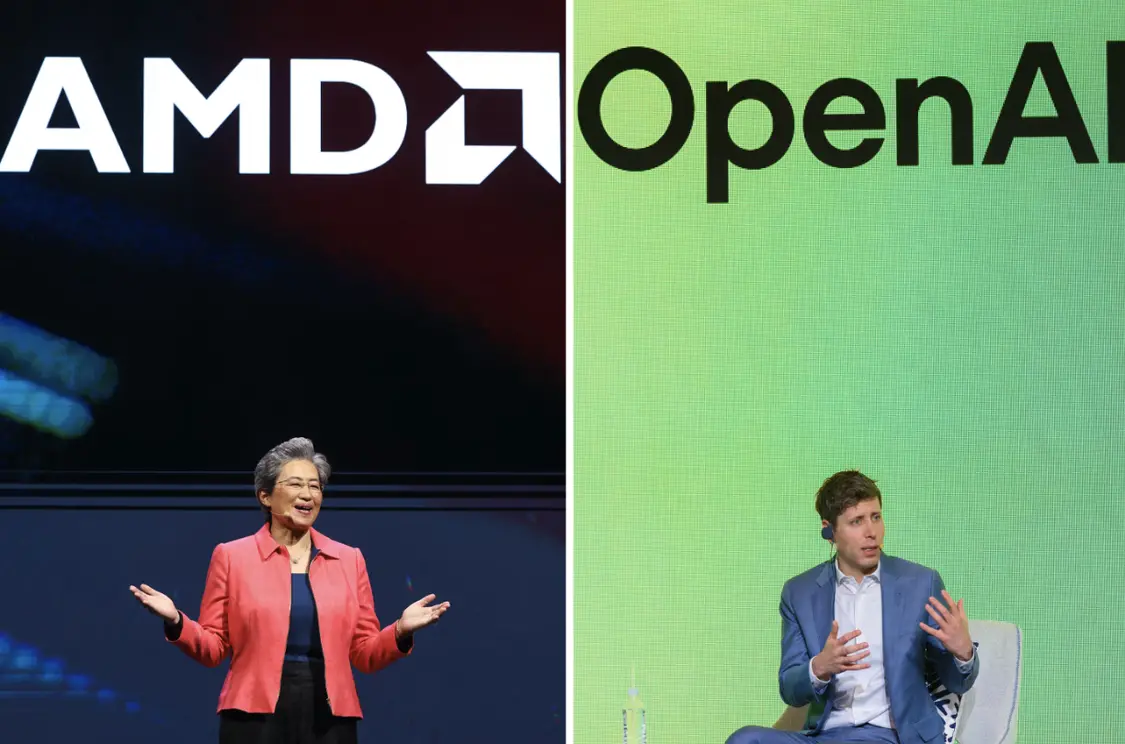
According to the agreement, OpenAI will collaborate with AMD to enhance its Instinct GPU product line, positioning AMD to better compete with Nvidia. As part of the deal, OpenAI will purchase and deploy up to 6 gigawatts of AMD computing power over several years, while AMD will grant OpenAI up to 160 million stock warrants, exercisable in tranches based on specific performance milestones. The final tranche can only be exercised if AMD’s share price reaches $600.
Before the announcement, AMD shares were trading around $165, but by Tuesday’s close, they had soared to $211. UBS analyst Timothy Arcuri estimated that if OpenAI retains all the shares until the end of the agreement, the holdings could be worth around $100 billion.
A Strategic Financing Model
The warrant program is structured to vest in stages, each linked to specific share price targets. The sixth and final tranche requires AMD’s market capitalization to reach roughly $1 trillion. Arcuri suggested that OpenAI is unlikely to hold all the shares long-term; instead, it will probably sell portions of AMD stock along the way to fund its GPU purchases.
In essence, this arrangement allows AMD to finance OpenAI’s large-scale chip procurement using equity rather than cash, reducing OpenAI’s upfront costs for accessing massive computing capacity.
Validation Beyond Financing
Although Arcuri noted that this financing structure is “less economically attractive than Nvidia’s arrangement,” he emphasized that the strategic validation from OpenAI outweighs the financial cost. OpenAI’s endorsement signals that AMD’s AI GPUs are capable of handling the most demanding AI workloads, providing strong proof of performance for other potential clients.
AMD highlighted that it is also in discussions with additional customers and expects this agreement to accelerate adoption of its AI solutions. OpenAI’s validation gives AMD a strong foothold to market GPUs to cloud providers that already use AMD CPUs, potentially creating a snowball effect across the broader AI ecosystem.
The Real Cost: Market Absorption
Ultimately, the long-term cost of OpenAI’s large-scale AMD GPU purchases will likely be borne by retail and institutional investors, if they continue driving up AMD’s stock price.
This model contrasts with Nvidia’s $100 billion investment in OpenAI announced last month, which effectively financed OpenAI’s Nvidia hardware purchases while granting Nvidia equity exposure to the fast-growing AI leader.
For AMD, however, the deal—a form of financial engineering—gives it a low-cost entry into the next generation of hyperscale AI data centers, potentially capturing up to 30% of the market. Despite the financing risk, the strategic upside of partnering with OpenAI could prove transformative for AMD’s position in the global AI race.