This is what the largest, most valuable building on Earth looks like: Musk shows off the Terafab factory rendering blockbuster.
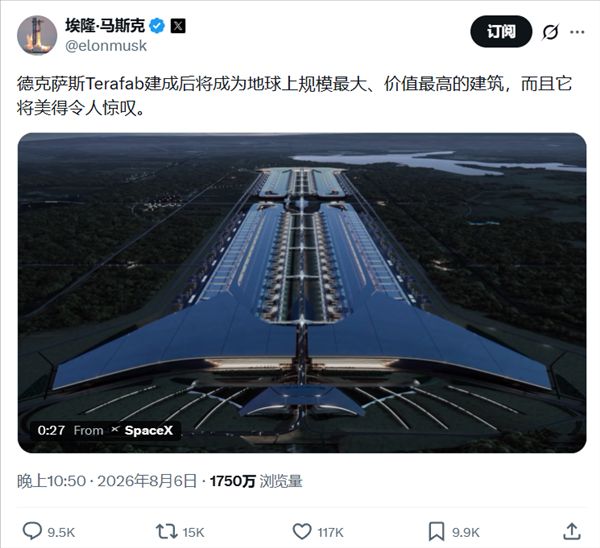
Recently, Musk posted a concept render video of Tesla's Terafab factory on the X platform, captioning it: "Terafab Texas will become the largest and most valuable building on Earth, and it will be breathtakingly beautiful." As of now, the video has garnered over 17 million views.
The render video shows that the exterior facade of the Terafab Texas building features sharply angled slopes, with multi-level interior spaces visible from outside through illuminated light bands. Beneath the elevated roads lie pedestrian plazas and reflecting pools, while the background skyline is punctuated by angular spires that feel more like sculptures than infrastructure — a stark departure from the purely utilitarian style of the Texas Gigafactory.
Terafab is an advanced semiconductor wafer fab jointly developed by Tesla and SpaceX, located in Grimes County, Texas. It is planned to have over 100 million square feet of manufacturing space, with an initial investment of $16.8 billion.
According to the SpaceX official website, the factory will integrate the manufacturing, packaging, and testing of advanced logic chips and memory devices, enabling rapid iterative deployment.

The chips produced will serve two purposes: on one hand, they will target edge computing and inference scenarios for Tesla's Optimus robots and Cybercab robotaxis; on the other hand, they will produce high-power chips for SpaceX's space data center operations.
Beyond the factory itself, the most eye-catching element in the video is the first-ever joint appearance of two products that have yet to enter mass production: the Optimus humanoid robot and the Robovan autonomous passenger shuttle.

In the footage, Optimus shuttles through the campus performing tasks, while Robovan glides along the elevated roads that run through the building, accompanied by Tesla Semi and Cybercab — Tesla's "future four-piece set" all gathered in a single video.
As Tesla's autonomous transport vehicle, the Robovan can carry up to 20 passengers at once or be converted for cargo use, with a target operating cost of 5–10 cents per mile (roughly one-tenth of the ~$1 per mile cost of traditional buses). It features a design with no steering wheel and no pedals, though there is still no clear mass production timeline in the near two years.
As for Optimus, progress is moving faster. The Fremont factory is currently retrofitting its production lines for third-generation Optimus manufacturing, and a second, larger facility is under construction at the Texas Gigafactory, with a target of mass production by summer 2027 and a long-term annual production capacity goal of 10 million units.

Related Articles

Huawei phone users have finally got what they've been waiting for! The HarmonyOS trial beta version of NetEase Cloud Music is now available.
about 4 hours ago
The price after discounts is 6544 yuan! Lenovo ThinkPad E14 2026 laptop is now available: Core 5 320 + 512GB
about 5 hours ago