SpaceX's market value dropped from $3 trillion to $1.6 trillion — what did the first financial report reveal?
After SpaceX's IPO, the market no longer blindly believes in Musk.
SpaceX released its Q2 FY2026 earnings report. It is a report that looks strikingly impressive. SpaceX's Q2 revenue was $7.814 billion, up 91.9% year-over-year; first-half revenue reached $12.508 billion, up 53.7% year-over-year; SpaceX's Q2 net loss was approximately $541 million, narrowed by about 46% compared with the loss in the same period last year; adjusted EBITDA reached $3.538 billion, up 191% year-over-year.
But the capital markets did not only look at growth. After the earnings report was released, SpaceX's stock fell 7.46% in after-hours trading. After SpaceX's IPO, the stock briefly rose to a high of $225.64, but then quickly fell 44% to around $125, and the market value also dropped from nearly $3 trillion to its current level of about $1.6 trillion.
The reason the market response was tepid is not because SpaceX's growth is not fast enough, but because investors have begun to ask: how much does it cost to buy this growth?
Data shows that in Q2, SpaceX's capital expenditures reached $18.369 billion, up 556% year-over-year. Among that, capital expenditures related to the AI business were $15.828 billion, accounting for about 86% of total capital expenditures for the quarter.
Before the IPO, Musk talked about stars and seas, global internet, AI infrastructure, and a trillion-dollar revenue target; after the IPO, the market began to test SpaceX's ability to monetize these stories.
01 Starlink makes money, AI burns moneySince its founding in 2002, SpaceX's core businesses have always been rocket launches and satellite internet. But during the IPO period, the focus of SpaceX's narrative has clearly shifted toward AI.
By business segment, SpaceX currently mainly consists of three core segments: Connectivity, Artificial Intelligence (AI), and Space Launch.
However, the pace of these three business segments is not the same: Starlink has entered a mature stage and is the main source of revenue and profit; the AI business is growing the fastest but also burning the most cash; Space Launch is the ceiling of future imagination and is still in a phase of sustained investment.
The relatively mature and stable connectivity business is SpaceX's largest foundation. In Q2, Starlink's revenue was $4.291 billion, up 65.8% year-over-year; operating profit was $1.656 billion, up 79.4% year-over-year. This is also the only segment that achieved operating profit in SpaceX's latest fiscal quarter.
Currently, Starlink has 12 million subscribers, doubling from 6 million in the same period last year. Behind this is SpaceX's scale advantage in the global low-Earth-orbit satellite broadband market. Data shows that Starlink covers 167 countries, regions, and markets, with more than 10,200 Starlink broadband and mobile satellites in orbit.
SpaceX believes the company still has opportunities to expand service coverage in existing operating regions and increase the number of enterprise and government customers. Musk told investors on the conference call: "At some point in the future, it is not impossible for Starlink to provide most of the world's internet services. This is not something far off — it can be achieved in less than 10 years."
However, one detail worth noting is that Starlink's ARPU has fallen from $85 per month in the same period last year to $66, and it has remained at this level in both Q2 and the first half.
The decline in ARPU is mainly related to international expansion and an increase in lower-priced plans. Starlink initially served high-income markets such as North America, where average revenue per user was naturally higher; as the business expands to more emerging markets, user growth accelerates, but payment capacity and plan pricing are also pulled down.

SpaceX's main Q2 financial indicators | Image source: earnings report screenshot
By contrast, the AI business is the most watched part of this report. In February 2026, SpaceX acquired Musk's artificial intelligence company xAI through an all-stock transaction and integrated the related business into the company.
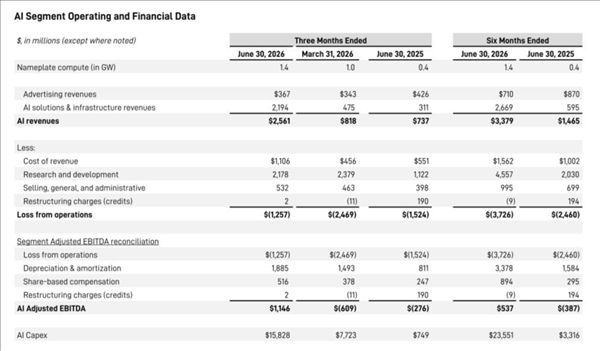
Data shows that the AI division's Q2 revenue was $2.561 billion, up 247.5% year-over-year; first-half revenue was $3.379 billion, up 130.6% year-over-year. On the surface, this is explosive growth. But looking at the breakdown, the growth mainly comes from AI Solutions & Infrastructure, especially AI infrastructure cloud service contracts.
The earnings report disclosed that AI Solutions & Infrastructure Q2 revenue was $2.194 billion, compared with only $311 million in the same period last year; first-half revenue was $2.669 billion, compared with $595 million in the same period last year. Advertising revenue, on the other hand, is declining — only $367 million in Q2, compared with $426 million in the same period last year.
SpaceX's AI business Q2 performance | Image source: earnings report screenshot
This shows that X platform's advertising business has not become the core of growth, and is even shrinking. The real growth in the AI business comes from computing services, Grok and X subscriptions, APIs, data licensing, and cloud services.
Currently, SpaceX has carried out data center leasing cooperation with companies such as Anthropic, Google, and Reflection AI. Among them, the scale of SpaceX's cooperation with Anthropic is approximately $1.25 billion per month, and the project was gradually launched in May and June; the cooperation with Google has not yet officially begun.
In the previous quarter, the AI segment's loss was as high as $2.47 billion, and the market once worried that it would become a "bottomless pit" for SpaceX's profits. But entering Q2, the AI segment's loss narrowed to $1.26 billion, lower than market expectations.
However, the AI business's capital expenditures remain massive. In Q2, SpaceX's capital expenditures in the AI segment were $15.828 billion, mainly used to expand the Colossus data center cluster, as well as supporting power and natural gas energy infrastructure construction.
This is where the market's real concern lies. The AI business is not a light-asset software subscription model, but a heavy-asset infrastructure model. It requires not only training models, but also building data centers, purchasing GPUs, deploying power, and so on. The faster revenue grows, the higher the demand for computing power and infrastructure may be, and cash consumption will also be amplified.
02 Nearly $100 billion just arrived, AI infrastructure starts sprintingBesides Starlink and AI, space launch remains SpaceX's most iconic business. In late July, SpaceX received a $1.6 billion launch order from the U.S. Space Force; earlier this year, they also obtained a national security satellite agreement worth approximately $6.5 billion from the Space Force.
Overall, the Space business segment brought in Q2 revenue of $962 million, up 29% year-over-year, but its operating loss also expanded from $369 million to $542 million.
The main reason for the expanded loss is increased R&D investment. In Q2, the Space division's R&D expenses were $1.076 billion, up 55.3% year-over-year; first-half R&D expenses were $2.006 billion, up 64.6% year-over-year.
The earnings report disclosed that Falcon launches totaled 77 in the first half, compared with 81 in the same period last year; among them, customer launches were 17, compared with 21 in the same period last year. Starship had 1 launch in the first half, compared with 3 in the same period last year. Total orbital mass in the first half was 1,041 tons, including 908 tons of internal payload and 132 tons of customer payload.
It is worth noting that SpaceX currently holds a massive amount of cash. The earnings report shows that as of June 30, 2026, SpaceX held $93.522 billion in cash and cash equivalents, plus $6.487 billion in marketable securities. In other words, SpaceX's liquidity resources are close to $100 billion.
This mainly comes from the IPO completed in June 2026. SpaceX issued 638.9 million shares of Class A common stock at $135 per share, and after deducting underwriting fees and offering expenses, net proceeds were $85.675 billion. At the same time, SpaceX also issued $25 billion in senior unsecured bonds.
However, being cash-rich does not mean things have become easier. In Q2, SpaceX's quarterly capital expenditures were as high as $18.369 billion, of which the AI division's capital expenditures were $15.828 billion. In the first half, SpaceX's cash outflow from investing activities was $34.487 billion, of which purchases of property, plant, and equipment were $28.476 billion.
Although the cash cushion brought by the IPO is thick, the burn rate is equally astonishing.
03 The first "hard battle" after the IPOIn the roughly one-hour conference call with analysts, Musk emphasized several of SpaceX's long-term goals. The most watched one is that SpaceX plans to achieve $1 trillion in revenue by 2030, a timeline that has been moved up from the original 2031.
Musk and other executives repeatedly stressed that the current large-scale spending is critical to SpaceX's strategy, especially in AI infrastructure construction.
"Although I have been in this industry for 24 years, I am incredibly excited about the coming months," SpaceX President Gwynne Shotwell said on the conference call. "It really feels like we are starting all over again."
However, for the market, the real short-term test will come two days later. On August 6, up to 912 million locked-up shares held by SpaceX employees and other pre-IPO shareholders are about to be unlocked. Based on the closing price of $125.33 on August 4, the corresponding market value is approximately $114 billion, roughly 1.4 times SpaceX's current public float.
This will also become the largest lock-up expiry in the history of U.S. capital markets. For secondary market investors, this is a confidence test.
Today, SpaceX is simultaneously advancing three highly capital-intensive businesses. Starlink needs continuous satellite launches, AI needs data centers and energy infrastructure, and Starship needs long-term R&D investment. Any one of these directions alone is enough to burn cash; when all three are combined, the test for SpaceX is amplified.
Before SpaceX's IPO, Musk could win over capital with "Mars," "global internet," and "super AI infrastructure"; after SpaceX's IPO, the market will continue to ask: Can Starlink's ARPU hold steady? Can AI cloud service contracts continue? When will capital expenditures peak? When will Starship shift from R&D investment to commercial returns? This is SpaceX's biggest and truly real challenge.
This article is an original work by GeekPark. For reproduction, please contact Geek君 via WeChat: geekparkGO
Geek question
After reading this earnings report,
do you think SpaceX is worth $1.6 trillion?
Related Articles

Huawei phone users have finally got what they've been waiting for! The HarmonyOS trial beta version of NetEase Cloud Music is now available.
about 4 hours ago
The price after discounts is 6544 yuan! Lenovo ThinkPad E14 2026 laptop is now available: Core 5 320 + 512GB
about 5 hours ago