Let's first do the math on whether the iPhone can use domestic memory: utilizing just 3% of CXMT's production capacity would suffice.
As domestic memory technology rises, ChangXin Memory Technologies (CXMT) has become a force to be reckoned with in the global supply chain. To reduce its reliance on the big three memory makers, Apple is set to use CXMT memory chips in iPhones.
However, several hurdles remain before Apple can adopt CXMT memory, with the biggest obstacle being US domestic restrictions. Resolution may hinge on a major US-China event next month, where this could serve as a bargaining chip. Apple's use of CXMT memory within China should face few issues.
The remaining challenges are technical. Can CXMT's LPDDR5 and LPDDR6 meet Apple's requirements? There were once concerns about the quality of domestic chips, but by 2026 these will be moot. CXMT can already produce high-end memory chips using process nodes two to three generations behind, with DDR5 reaching 9000Mbps and LPDDR5X hitting 10667Mbps.
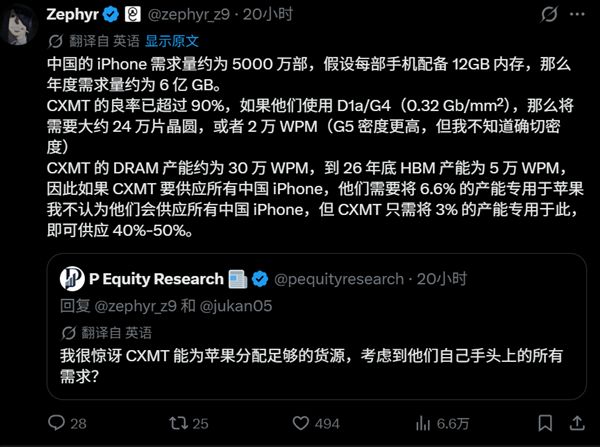
Another question is whether CXMT has sufficient production capacity, given that Apple is one of the world's largest buyers of memory and flash chips. Analyst Zephy on X has done the math on this.
China's iPhone demand is approximately 50 million units. Assuming 12GB of memory per phone, annual demand would be around 6 billion GB.
CXMT's yield rate exceeds 90%. If they use D1a/G4 (0.32 Gb/mm²), roughly 240,000 wafers would be needed, or 20,000 WPM (G5 has higher density, but I don't know the exact figure).
CXMT's DRAM capacity is about 300,000 WPM, with HBM capacity at 50,000 WPM by the end of 2026. So if CXMT were to supply all iPhones in China, they would need to dedicate 6.6% of their capacity to Apple.
I don't think they'll supply all Chinese iPhones, but CXMT could cover 40-50% of demand by dedicating just 3% of their capacity to this.
His calculation suggests that CXMT only needs to allocate 3% of its capacity to Apple to meet nearly half of domestic iPhone demand. This makes earlier rumors of CXMT rejecting Apple's orders unlikely. From CXMT's perspective, securing Apple as a customer would be hugely significant—far beyond just the revenue.
Even if Apple clears all obstacles and starts using CXMT memory in China-market iPhones, the transition won't happen overnight. Switching 10-20% of the 50 million domestic shipments in the first year would already be aggressive, with gradual increases only after the partnership is established.
This is also good news for CXMT, as their current challenge is insufficient capacity. They're investing heavily in expansion, with greater determination and speed than Samsung and others. The other three companies are actually reluctant to expand rapidly, fearing memory price drops. But CXMT is different—once capacity comes online, they have no trouble selling it, and capturing even a small share from Samsung, SK Hynix, and Micron would be a major win.
In a sense, the recent memory and flash price increases have given domestic chipmakers a rare opportunity for rapid growth. Previously, they could only compete on low prices—they've never fought such a well-funded battle. The only constraint now is the pace of capacity expansion, as domestic semiconductor equipment cannot yet fully replace foreign alternatives.
Related Articles
Huawei phone users have finally got what they've been waiting for! The HarmonyOS trial beta version of NetEase Cloud Music is now available.
about 4 hours ago
The price after discounts is 6544 yuan! Lenovo ThinkPad E14 2026 laptop is now available: Core 5 320 + 512GB
about 5 hours ago