Even with tariffs as high as 127.5%, it's still worth it! Google's Waymo autonomous driving company has already purchased 3,200 Chinese vehicles.
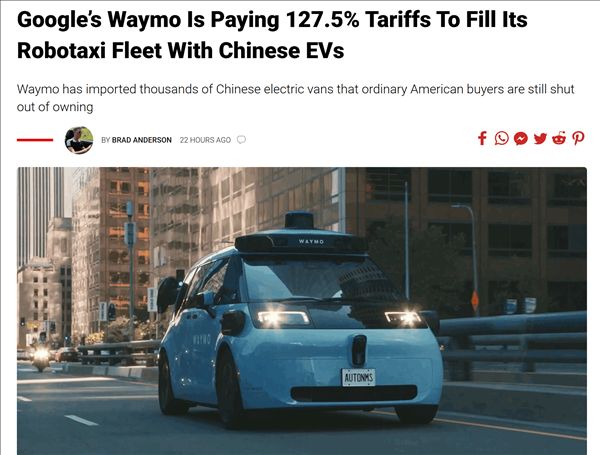
According to Carscoops, Google's autonomous driving subsidiary Waymo has imported over 3,200 China-made Zeekr electric vans since 2024 to expand its Robotaxi fleet, with more than 2,600 units arriving in the U.S. this year alone.
Customs bill of lading data from research firm ImportGenius shows these Zeekr CM1-E vehicles (the domestic counterpart is the Zeekr MIX) entered through the Port of Los Angeles, with Waymo importing an average of about 300 units per month. Although the bills of lading do not directly list Waymo as the consignee, Zeekr has no other partner automaker in the U.S., so these vehicles are essentially confirmed to be exclusively for Waymo.
Notably, the U.S. imposes tariffs as high as 127.5% on Chinese electric vehicles, making them completely unaffordable for ordinary American consumers.
For comparison, the Zeekr CM1-E sells for around $39,000 in China, with a declared customs value of approximately $38,000. After tariffs, the landed cost rises to about $86,500. Adding roughly $25,000 per vehicle for Waymo's sixth-generation autonomous driving hardware and software, the total cost per vehicle easily exceeds $100,000.
Even so, Waymo still finds it worthwhile. Its current fleet's mainstay, the Jaguar I-PACE converted Robotaxi, costs over $200,000 per vehicle, and that model has already been discontinued.
In contrast, the Zeekr Ojai costs nearly half as much and is a purpose-built vehicle designed for passenger transport: flat floor, low step-in, sliding doors, a more spacious cabin, easier boarding and alighting, and lower long-term operating and maintenance costs.
Additionally, to circumvent the U.S. "Connected Vehicle Final Rule" restrictions on Chinese software and hardware, Waymo imports the vehicles as bare chassis without autonomous driving or connectivity features. After arriving at its Mesa, Arizona facility, they are equipped with Waymo's self-developed sixth-generation sensor and computing platform in partnership with Magna.
Since the rule exempts contracts signed before 2030, and Waymo's partnership with Geely was announced as early as 2021, these vehicles are legally permitted on U.S. roads.
Currently, over 100 Zeekr vans named "Ojai" are already in operation in Los Angeles and San Francisco. As of July this year, Waymo's global fleet stood at approximately 3,900 vehicles, with a goal of reaching 1 million paid rides per week by year-end.
Industry insiders had generally expected Waymo to import at most 1,000 units due to tariffs, but reality has proven the actual scale far exceeds expectations.
On one side stands the 127.5% tariff wall; on the other, an import pace of 300 units per month. This demonstrates that the cost and manufacturing advantages of Chinese EVs are not easily erased by tariffs.
Related Articles

Huawei phone users have finally got what they've been waiting for! The HarmonyOS trial beta version of NetEase Cloud Music is now available.
about 4 hours ago

The price after discounts is 6544 yuan! Lenovo ThinkPad E14 2026 laptop is now available: Core 5 320 + 512GB
about 5 hours ago