CPO Switches Finally Mass-Produced! NVIDIA and Broadcom Act Together: But Three Major Bottlenecks Pose Challenges
NVIDIA has begun shipping the next-generation Spectrum-X CPO switch to designated partners, and Broadcom is also continuously delivering small batches of the 51.2T Bailly CPO switch, marking the official entry of co-packaged optics technology into mass production.
CPO switches are core network equipment in data centers that handle high-speed interconnections between servers. In AI training clusters, thousands of GPUs need to exchange massive amounts of data with each other, all relying on such switches. Traditional solutions use pluggable optical modules, which consume a lot of power. CPO integrates optical components directly with the switch chip, saving power and increasing bandwidth, making it the preferred architecture for next-generation high-bandwidth switches.
According to the latest report from TrendForce, NVIDIA's Spectrum-X CPO switch was jointly developed by NVIDIA and TSMC, using TSMC's advanced COUPE packaging technology. Its switching capacity can reach up to 400 Tb/s, with further expansion expected in the second half of 2026.
Broadcom's 51.2T Bailly CPO switch has entered volume production, supported by Delta Electronics and Mellanox. Compared to traditional pluggable optical transceivers, this solution reduces power consumption by up to 70% and has completed deployment validation at hyperscalers like Meta.
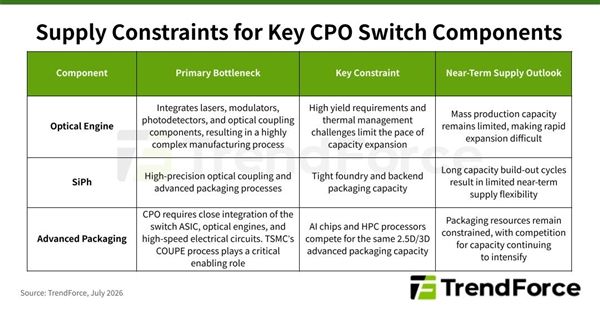
However, TrendForce points out that three supply-side bottlenecks may constrain market growth.
The first bottleneck is the optical engine, which integrates lasers, modulators, photodetectors, and optical coupling components into a highly complex module. It demands extremely high yield and heat dissipation, and only a few suppliers currently have mass production capabilities.
The second bottleneck lies in silicon photonics, where wafer manufacturing and advanced packaging require extremely high precision and reliability. The production capacity build-up cycle is long, making it difficult to flexibly increase supply in the short term.
The third bottleneck is advanced packaging. CPO switches increasingly rely on technologies like COUPE and must compete with AI chips and high-performance computing processors for the same 2.5D/3D packaging resources, further tightening supply.
Supply chain pressures are driving a clear divergence in vendor strategies. Some cloud service providers are securing supply through long-term purchase agreements and strategically investing in upstream silicon photonics suppliers. NVIDIA is deepening its alliance with TSMC to advance vertical integration, while companies like Google are opting to develop their own optical components to reduce reliance on external suppliers.
TrendForce believes that vertical integration is becoming the default industry path. Vendors that can independently control silicon photonics design, optical engine manufacturing, and advanced packaging will hold a leading position when the CPO switch market scales up in 2027–2028.
Related Articles

Huawei phone users have finally got what they've been waiting for! The HarmonyOS trial beta version of NetEase Cloud Music is now available.
about 3 hours ago
The price after discounts is 6544 yuan! Lenovo ThinkPad E14 2026 laptop is now available: Core 5 320 + 512GB
about 4 hours ago