Google's major personnel reshuffle: The myth of Indian-origin CEOs is over — when it comes to AI, it's Chinese-origin talent that gets the job done.
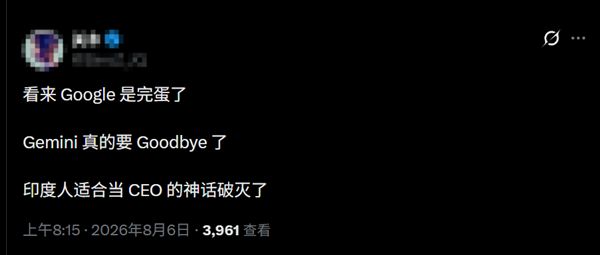
Among the US AI big three, Google has clearly fallen behind this year. Early this morning, it announced several major personnel changes, and several AI luminaries who laid the foundation for the company's AI efforts have left again, sparking widespread discussion.
This is not the first time Google has experienced an AI talent drain. The previous wave of intense changes was at the end of June, when the eight core authors of the Transformer paper gradually left one after another. Counting this round of changes, the heavyweight AI expert team that defined Google's AI era has almost completely turned over, which also caused Google's stock price to plunge 4%.
Whether Google's major AI talent overhaul can bring the Gemini large model back to its peak remains uncertain, but Google's high-profile start and subsequent decline in the AI field has sparked another discussion: the narrative myth that American media touted years ago has been shattered — very few tech giants led by Indian-origin CEOs have done well in the AI era.
Google CEO Sundar Pichai has been in the position for 11 years. When he first took on this role, the internet was full of praise for Indian-origin elites becoming leaders in the US tech industry. At that time, many executives in the US high-tech industry were Indian-origin talents.
Earlier than Pichai, Microsoft CEO Satya Nadella took the helm of the tech giant in 2014. Along with other companies such as Adobe, IBM, Micron, and Palo Alto Networks, whose CEOs are also of Indian origin, hiring Indian-origin CEOs briefly became the standard practice for US tech companies looking to turn their fortunes around.
However, in the AI era, whether it's Microsoft, Google, or the other companies mentioned above, firms led by Indian-origin CEOs have all missed opportunities in large AI models. Especially Microsoft and Google — despite having the industry's top resources in capital, talent, and computing power — their large model businesses have either remained largely invisible or started strong before fading into mediocrity.
Among US companies, Micron might be the one where an Indian-origin CEO has had a highlight moment in the AI era, but the company's current surge in performance is more due to memory and flash price increases. Without this price hike cycle, Micron would still have been posting huge losses in 2023 and 2024.
In the AI era, the US companies that have done well are instead those with Chinese-origin talent as CEO or leading R&D. It's no longer news that the CEOs of the three major AI chip companies — AMD, NVIDIA, and Intel — are of Chinese descent. Many core researchers at OpenAI and Anthropic are also Chinese-origin, even international students who came from China. The same holds true at Microsoft, Google, Amazon, Meta, and others.
Related Articles

Huawei phone users have finally got what they've been waiting for! The HarmonyOS trial beta version of NetEase Cloud Music is now available.
about 4 hours ago
The price after discounts is 6544 yuan! Lenovo ThinkPad E14 2026 laptop is now available: Core 5 320 + 512GB
about 5 hours ago